


I pop on the goggles and everything gets fuzzy and fish-eyed. The first few movements are haphazard and scared as my right knee, my new eye, lunges forward. Everything feels discombobulated; there’s vision, but it’s the wrong vision. I can hear Shin Hanagata (*1995), the madcap architect of the device I’m wearing, scurrying to move a laptop and iced coffee so I don’t tumble over them. I nearly crash into the wall. “Please put your head on the ground,” he instructs, so I dip my head backward as if I’m laying in a hair salon bowl. With every tentative crawl, I start to slip into my new form; my arms become hind legs, my crotch and torso become the neck, my head becomes a useless trinket dangling in the back like a tail. My knee-eye gazes upward and I see a massive, pulsating anus.
We’re at the TAV Gallery in Tokyo, where Shin’s exhibition, “Mitai: Retroactive Media Theory,” has just opened. It’s about body parts. Surrounding me on all sides are all the sides and insides of the artist himself: the underhang of a tongue, the glistening “urethral meatus,” ear-holes and ridged rectal entrances that look like the abyss. They’re extra vivid because Hanagata has just strapped me into CHIMERIA, a device which forms the basis for a work that received an Award of Distinction at Ars Electronica 2026. He will showcase it as a durational performance and a short documentary at the Linz new media festival this September. The device combines a camera, which you can attach wherever on your body, with goggles, which live-stream the feed from a new set of eyes.
Hanagata wrote a short manifesto about what he calls “twisting,” or doing things that annihilate the head-driven, bipedal structure of human existence. That standardized form has facilitated our current condition as screen-fixated nodes in the algorithm. For CHIMERIA, Hanagata wondered what could happen if he let a crew of volunteers thoughtfully fuck around with the device, encouraging them to rebirth themselves as virgin mutants. He told me about the results: the new customs, tactics, and prosthetics that emerged, along with his desire to wake people up and feel life in the rawest possible way.
Kieran Press-Reynolds: How long did this device take to develop?
Shin Hanagata: This one, about a month. It was really simple because this camera and these goggles are already existing products; the goggles are usually used by real-time drones.
KPR: Were there other stages of this idea before you found these goggles? You have a lot of work related to negating the body or going into some other bodily form – your 2021 work Uber Existence was a fictional service where people could live vicariously through other humans, whom they could control like delivery drivers from the safety of their bedroom.
SH: This device was first used in a previous version of CHIMERIA called Still Human (2021). I hosted a very tiny camp with a few participants back in 2021, and then I came up with the ideas. I usually use the word “twist” – if I make the body twisted, the world twists with it. If you attach the eyes to the knee, for example, your relationship with objects must adapt. A door handle says “reach out and grab me,” but with the eye on the knee, you no longer know what your hand is, and the hand isn’t at that distance anymore; you only have the memory of a hand. You can remember how to use everyday objects, but that memory is for the previous body.
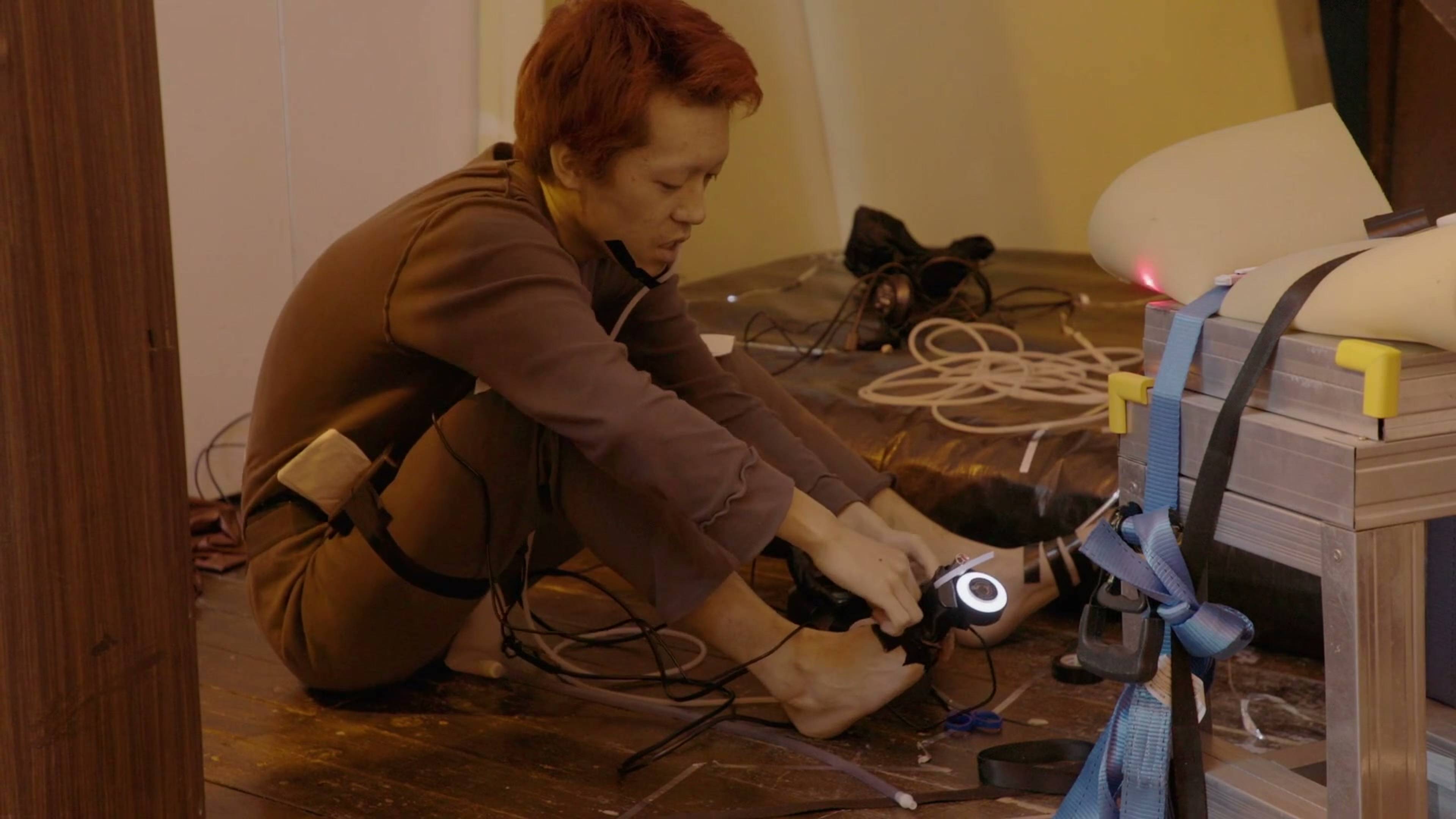
View of CHIMERIA, “Shin fitting foot,” Shinjuku Whitehouse, Tokyo, 2025. Photo: Takahiro Ueno
KPR: So for CHIMERIA, you did a bigger camp. Where?
SH: A really punk place in Tokyo called the Shinjuku Whitehouse, built by the famous architect Arata Isozaki in 1957.
KPR: Can you describe the camp itself?
SH: Everything else comes out of it, so let me describe it properly.
We spread a phone number around the city, on posters in Shinjuku and online. If you called it, a recording asked for your oldest memory and one secret.
KPR: Any good secrets?
SH: One of them said she peed many times on her grandfather’s well-manicured garden.
I invited the ones who were very honest, funny, or curious to the camp. About fifty people called the number in total. Seven came to the fitting inspection in December 2024, and five became what I call “chimeras.”
Each participant chose where to fix the camera: the knee, the foot, the elbow, the armpit, the hand. So, every chimera in the house had a different eye, a different body, and a different set of problems to solve. On the first day, when someone decided their camera’s position, I tattooed a small, filled circle, an eye mark, on that spot. I did the tattoos myself, including the one on my own foot. All of us still have them.
The camp ran for eighteen days in January and February 2025. People could go home at night, but some nights, they stayed in the house with the device on. Nothing here is virtual: it is an analog camera wired straight into the display, with almost no delay. You are looking at the real room, from the “wrong” place. In the first minutes, the map of your body collapses. You cannot stand, you cannot find your own hand, you cannot open a door. Then, over hours and days, the nervous system starts to reorganize around the new eye.
Everything in that house was made for a body with eyes in the head, so we had to rebuild daily life. That is the output of the camp: a set of inventions for a body that does not exist yet. When the eighteen days ended, I left everything where it was, and opened the house as an installation for a week. Visitors covered themselves with cloth and moved quietly, like people observing an ecosystem.
I didn’t want to demonstrate a “device.” I wanted to know whether ordinary adults, people who have already internalized this system completely, could build another standard for the body. They did, and nobody was acting.
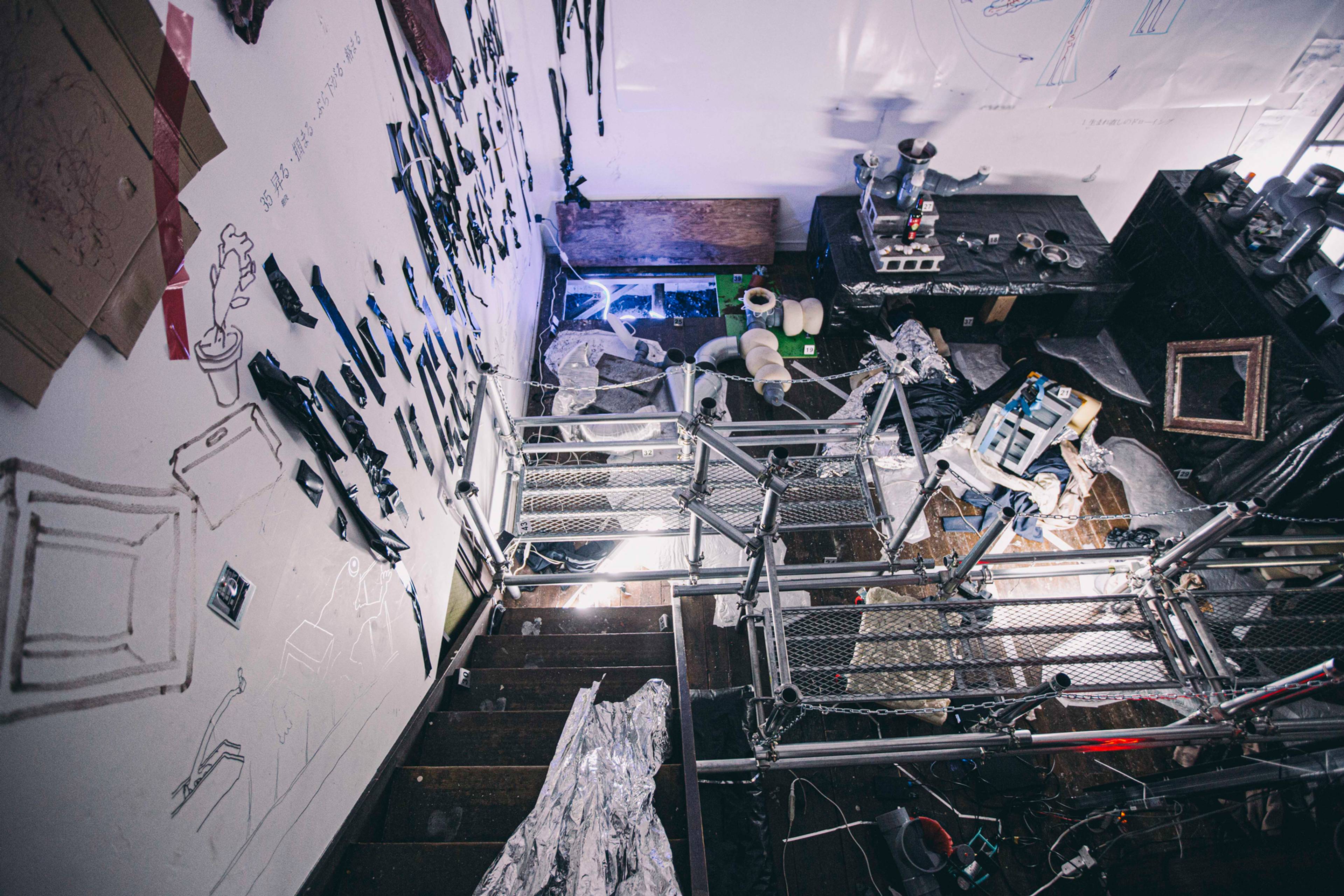
Shin Hanagata, CHIMERIA, 2025—. Installation view, Shinjuku Whitehouse, Tokyo, 2025. Photos: Rakutaro Ogiwara
KPR: Could you tell me about some of the customs that spawned to fit the chimera life?
SH: One of them was knee-peeing. My camera was on my foot, so an ordinary toilet is unusable. I can’t see my own penis, and aiming between the legs is hopeless.
KPR: If you put the camera on your toe, it’s like you’re peeing from your neck.
SH: Yes! So we ran a tube from the crotch down to the tip of the knee. The urine comes out at the knee, into a small bowl on the floor, and from the eye on my foot, I can see both the tube and the bowl. I made it with the product designer Takuto Ohta.
One more innovation is eating. It’s not complicated: we fix the end of a tube just under the camera, so the tip is always inside the frame, and you drink through the eye. The problem of solid food is still unsolved.
After adjusting to mutant eyes, the foot appears in the frame and starts to work like a nontraditional arm. In that gap, before the world is named again, you feel it raw. You’re reborn.
KPR: Do you have ideas for other prototypes?
SH: I want to make a charging port, where you can recharge the device’s battery without taking it off. Like a cyborg bed, so you could sleep and wake up without taking it off. I haven’t done twenty-four hours yet. I am very curious what happens after several days without a break as a chimera.
KPR: Yeah, I feel like the way to get what you’re trying to achieve is complete immersion.
SH: Yeah. One of the participants, Tomoaki Sakaguchi, slept with the device. When he woke up, I said “good morning” to him, but he could not respond. [The camera] was attached to his elbow, and he moved around really fast. He lost his – how to say it? – his human mind. He could use his legs, but his presence was totally different.
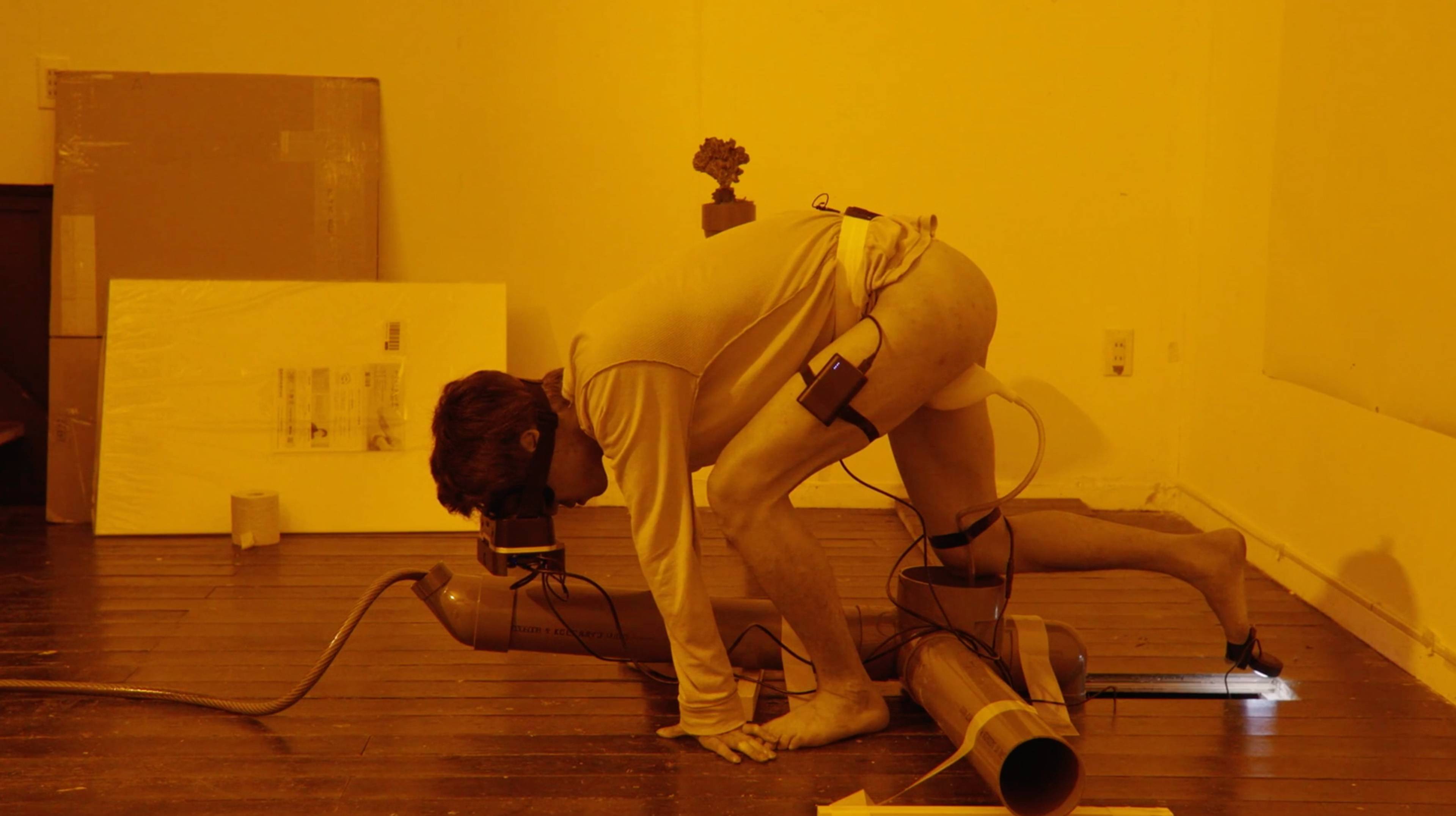
“Knee-peeing”
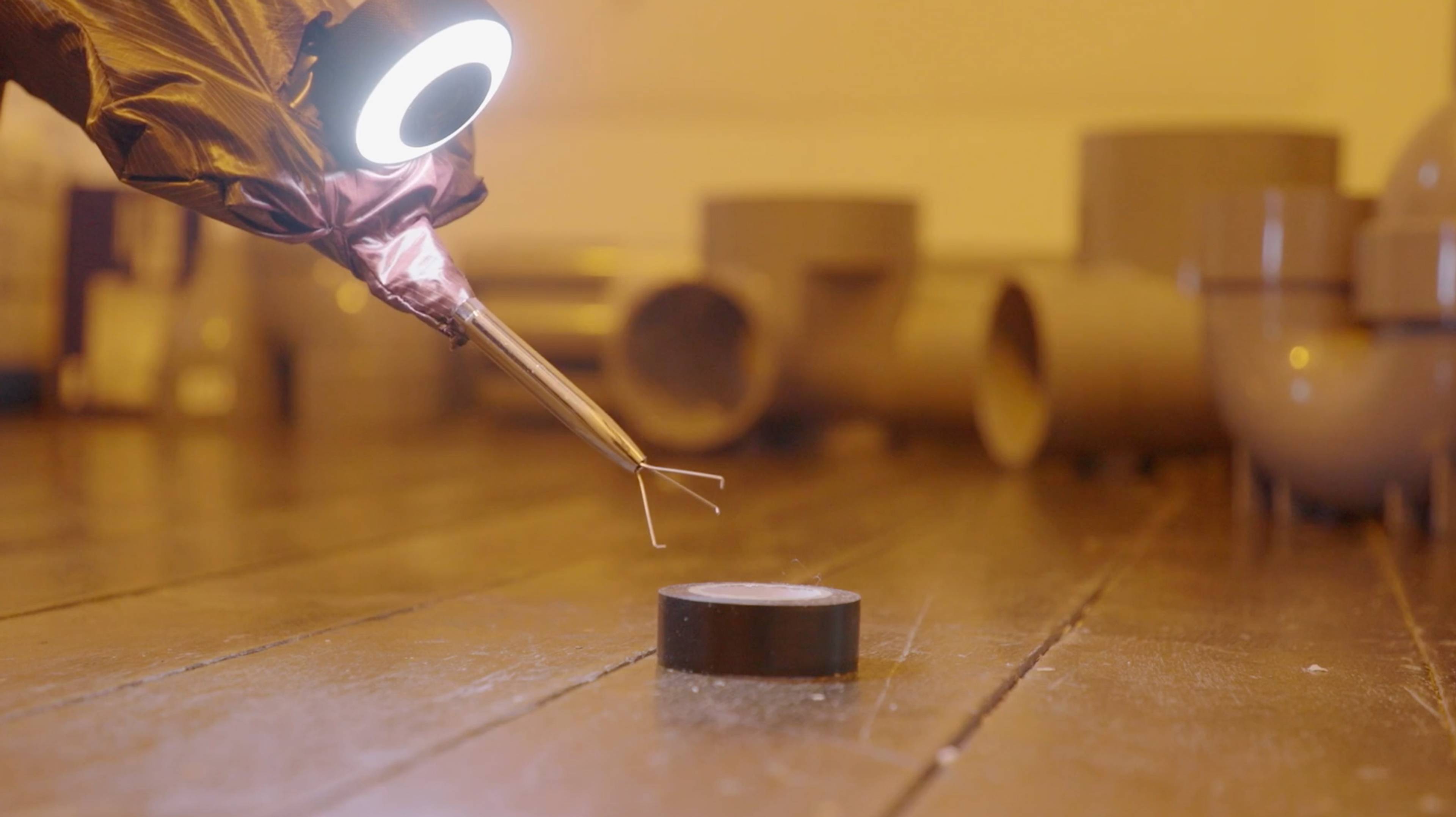
“Grabbing.” All views: CHIMERA, Shinjuku Whitehouse, Tokyo, 2025. Photos: Takahiro Ueno
KPR: One thing I was wondering: Could people have romantic relationships while wearing the device? Did anyone in the Whitehouse fall in love?
SH: It’s a really primitive feeling, because it happens without language. Language was made for a body with the eyes in the head. For a chimera body, the world is strange and language-less. It’s not romantic, but it is very close, like being babies who touch each other to check the environment.
In Still Human, there was definitely a romantic moment, with people in bed together. The camera is a sensual organ. When we first put two cameras together, I felt something like a sweet electric current, nothing I had ever felt before. Like the first time you press your lips on someone’s as a child, before you know what kissing is.
KPR: Like, you touched two cameras together?
SH: Yeah.
KPR: Oh.
SH: Then, “Was that a kiss or not?” [Makes soft moaning sounds]
KPR: Was it really good?
SH: Yeah, really. But [I was] embarrassed.
I want to inspire people to demote the bipedal world: to strip our current reality of its status as the only possible one.
KPR: Where else did people put the cameras – the armpit?
SH: Yeah, I put the camera in my armpit. My body axis was off. On the side of my body where the camera sat, I felt like I had only one, light arm, because my new eyes were so close to it. The other half felt like it had three arms, and it became heavy, like a very unbalanced octopus. I needed mass to balance myself out, so I grabbed a chair every time.
KPR: The ideas you write about in “The Twisting Manifesto” – reorienting the objective version of reality, wanting to reject the human self optimized into nodes for the algorithm, modules in the supply chain – don’t come from nowhere. What began your awakening there?
SH: It’s connected to the beginning of Uber Existence. I worked as a delivery driver during Covid, when rich people ordered food to not expose themselves to the virus. But I had to go out, and I felt like a machine: I couldn’t control myself or know which area I would be in during even the next few minutes. It was a really crazy situation, but I also found some joy in it – as a module you decide nothing, and the self almost disappears. That was a relief. But then, one time, I fell down a staircase during a delivery. It was 2am, I crashed on the ground, and the sky was really black. That’s the moment when I broke out of the system. For a few minutes, my body stopped working as a delivery unit. I couldn’t get up, so the app, the order, the route, none of it could reach me. There was a metallic pain ringing inside my head. In that state, I thought: What am I actually doing? The machine was broken; I mean, the machine I was a module of. When the machine stops, you can suddenly see the whole macroeconomic and social structure you were inside.
CHIMERIA, unlike Uber Existence, is not a work of irony about capitalism. It’s hope, I think, and the hope is specific. When a group becomes chimeras together, they build their own environment, a chimera-centred territory. At that moment, the world of “humans with eyes in the head” becomes relative. It’s not like some book of philosophy that disrupts your worldview. This is something written into the body, the nervous system.
To live as a body that carries that possibility is a huge hope, when you are otherwise stuck in this body, this culture, this capitalism. When the eye moves, every normal object refuses you. A chair, a staircase, a cup: you can only remember how to use them with old hand-eye coordination. After adjusting to mutant eyes, the foot appears in the frame and starts to work like a nontraditional arm. In that gap, before the world is named again, you feel it raw. You’re reborn.
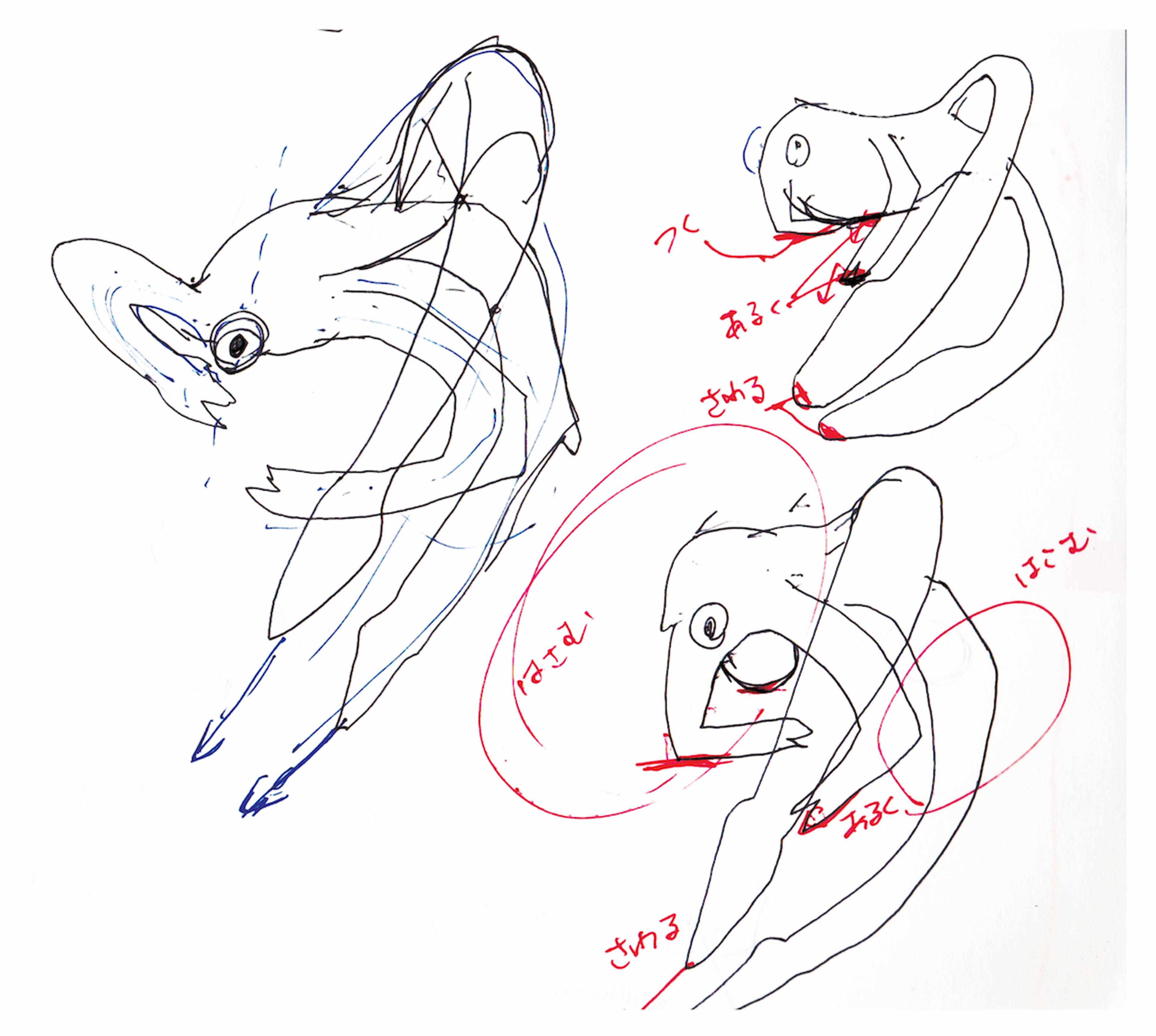
Shin Hanagata, drawing of how his body felt with the armpit eye
KPR: Is there something distinctly Tokyoite or Japanese about your work?
SH: Crowds in the Shinjuku Station [the busiest rail station in the world] are very good at passing through, very smoothly, seamlessly. I expect that I know them, and they know me, and the ways that I move – I feel like 0.5 of a person, like the density of my existence is halved. I think because people in Japan don’t have such a strong self. Whereas, I went to New York and Switzerland recently, and I felt [the people there] had a really strong self.
KPR: Did you feel like you didn’t have a sense of self growing up, that you had to fight for it?
SH: Hachiōji, where I grew up in west Tokyo, was really boring, and a bad town for commuting to downtown Tokyo. [I felt] isolated. My father is an ordinary employee, he’s really good at being a module in a company.
KPR: But you didn’t want that life, I guess – how did you get into art-making?
SH: I went to a normal university, where, as part of an engineering-student research group, I made a wearable device related to electrical muscle stimulation, with which a user could remotely paralyze my arm. At that time, I wasn’t really thinking about arty concepts. I had to make an undergraduate engineering research paper, where the project appeared as a low-cost robot or something. It was really bullshit for me.
I moved to art school for my Masters, and I was able to find a way to express this body curiosity of mine. But I’m not so interested in an artistic career, because I feel like I’m not an artist. I’m not an activist, either; I’m a practitioner or something. I want to inspire people to demote the bipedal world: to strip our current reality of its status as the only possible one.
Language was made for a body with the eyes in the head. For a chimera body, the world is strange and language-less.
KPR: Is “twisting” something you’d want people around the country to try?
SH: Not only in Japan. I want everyone in the world who resonates with it to twist. I think that people who can easily adjust to this society, they don’t need twisting. But for people who have difficulty adjusting to this world mentally or physically, people who suffer within its hierarchies, all the people doomscrolling, I think it’s a critical way to get out of the system.
KPR: What were the earliest things that pushed you toward twisting, and what has influenced your work?
SH: I often [had] a dream in childhood: My body was all cut up, my four limbs cut off, my organs spilled out. There was some despair in it, because everything those hands and legs could do was finished, and the human, social future was cut off. The only thing left was the quietness of giving everything up. But my brain remained really calm – I can’t say whether it felt good or bad. The feeling brings a very primitive nostalgia, this tranquility found inside irreversible despair.
As a child, I was also really crazy for this book, The Future Is Wild: A Natural History of the Future (2002) by Dougal Dixon and Joanna Adams, which speculates about what kind of animals will exist 200 million years into the future. I really envy the animals. The book was connected to a docu-drama series, and international versions of the book integrated AR features.
KPR: It’s interesting partly because so much of what we’re told to do now is to optimize. People are getting plastic surgery, they’re looksmaxxing, devouring slop-bowl efficiency lunches. The idea of the chimera is almost the opposite of that, making it harder to get anything done, basically. Are you interested in that kind of critique of efficiency culture?
SH: I don’t agree with transhumanism, which is interested in cyborgs that are hyper-efficient. I’m curious about the techniques, but I want to repurpose these technologies that want to make us better modules in the system. Transhumanism accelerates this world, whereas twisting wants to get out of it.
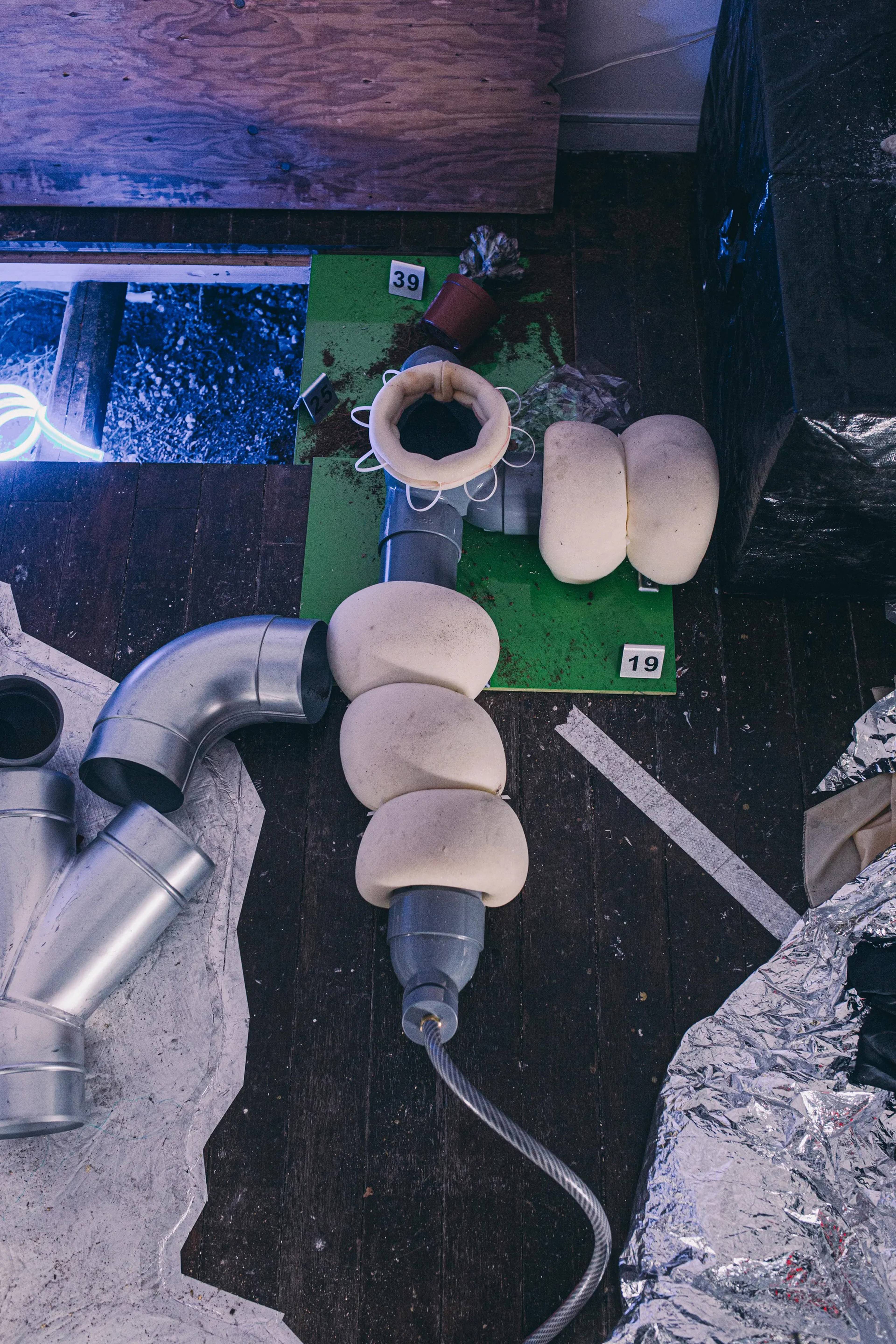
Shin Hanagata, CHIMERIA, 2025—. Installation view, Shinjuku Whitehouse, Tokyo, 2025. Photo: Rakutaro Ogiwara
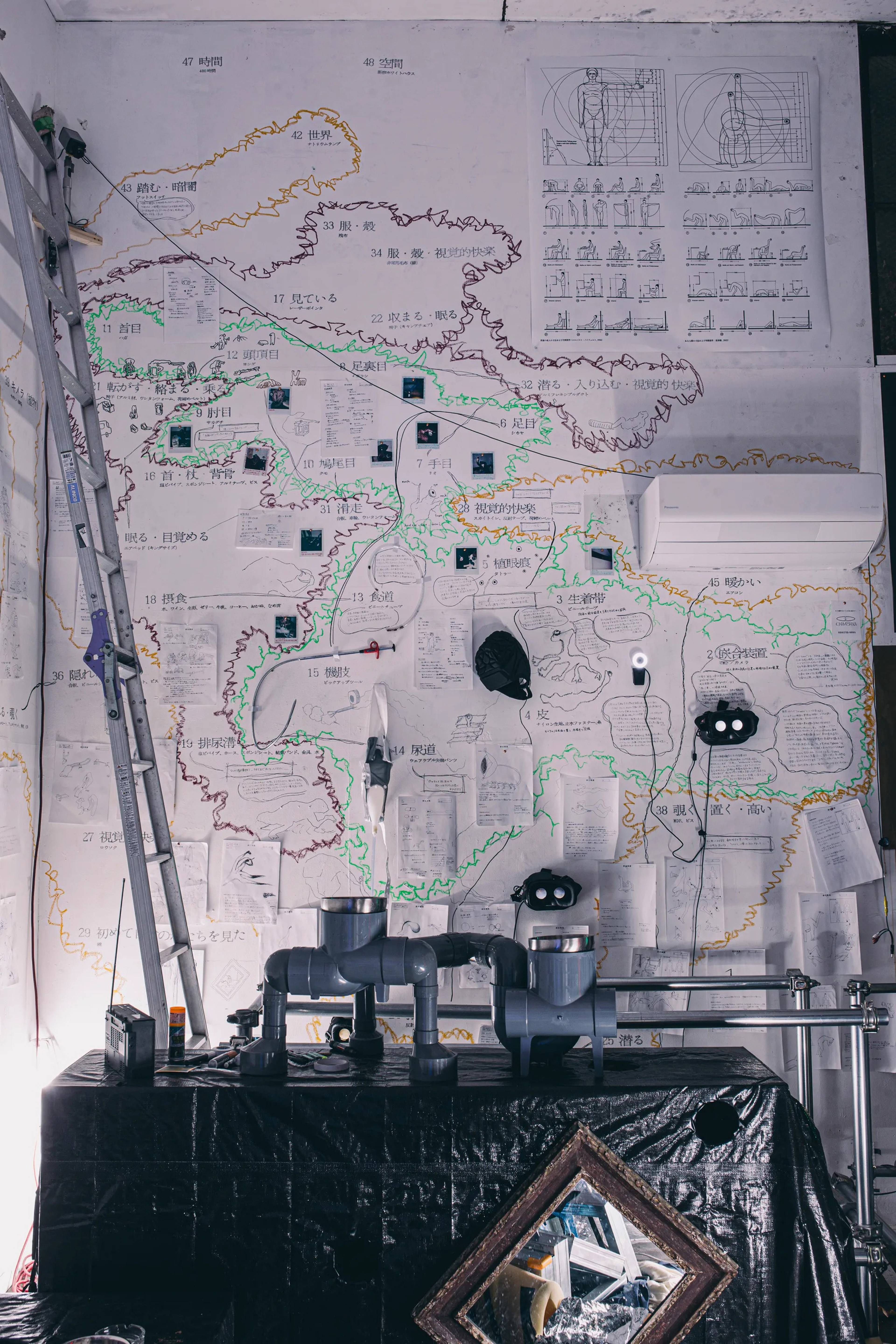
Shin Hanagata, CHIMERIA, 2025—. Installation view, Shinjuku Whitehouse, Tokyo, 2025. Photo: Rakutaro Ogiwara
KPR: I was thinking a bit about the Australian artist Stelarc.
SH: Ah yeah, my legend.
KPR: I feel like a lot of his stuff was about adding to human capability, like surgically stitching an ear to the arm, while your work is less about augmenting than dementing, distorting.
SH: Yeah. And also, I’m more interested in gathering participants. That’s why I like Fight Club (1999). Tyler Durden gathers men who are numbed out by capitalism and puts them in an underground ring, and by hitting each other, they get the sensation of the body back. It isn’t about winning the fight. What matters is that while hitting each other, your body is here. It's a real sensation, completely outside capitalism, and they run into it by accident. And I resonate with the way Tyler spreads that underground, across the whole country.
KPR: Do you feel sick of being in this world?
SH: Mm, yes. I’m suffering as a module, but I could also feel joy being one.
KPR: There’s a tension there.
SH: Yes. Being an artist, being social, even being an ordinary man is really hard in this society. But the friction itself is neither good nor bad. When I feel it, the pain, the powerlessness, the despair about society, something real arrives with it. That’s the contradiction: the pain is what tells me the sensation is genuine. And that is my motivation to go to another structure of the body.
I want to repurpose these technologies that want to make us better modules in the system. Transhumanism accelerates this world, whereas twisting wants to get out of it.
KPR: Are politics attached to the chimera? Or, what does the chimera want to do to society?
SH: I want the participants to feel like they have another possibility of feeling reality, that the world and one’s biological structure are not absolute. I don’t know if this is political or not. In the manifesto, I wrote, “The absolute world will be demoted.” That is a really critical, existential point of this project.
KPR: Do you ever think about doing public displays à la Situationism? Would you have chimeras walk in the Tokyo Metro or something, interrupting daily life?
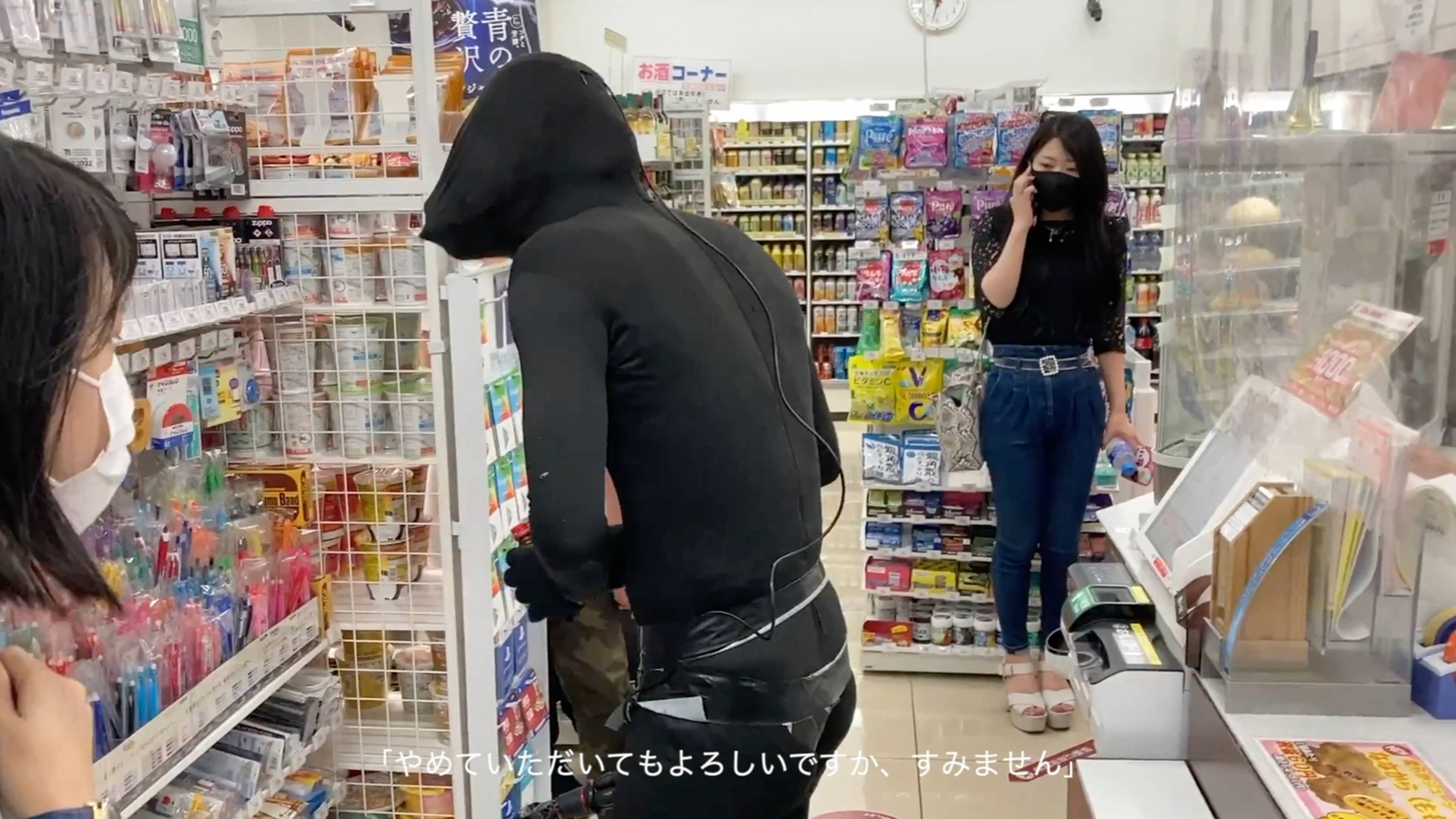
SH: I want to do that, and also I did something like that as part of Still Human. Tsu Tsu, a performer and artist who was part of the 2021 camp, went to a convenience store in Kabukicho on four legs. At the entrance he groped around and happened to grab a bottle of Chocola BB, a vitamin drink marketed to women, and tried to buy it. The clerk said, “Please stop this,” and he was forced to stand bipedally again, on two feet. He made a small apologetic gesture, let the friend who was with him buy the drink, and walked out like a human.
KPR: May all the konbinis get twisted. I was wondering, wouldn’t you eventually humanize even your chimera posture, get used to those positions? Because isn’t the problem not our eyes or legs, but our brains?
SH: I have two things to say about that. One is that I want to keep changing. So, if you’re used to the eyes being on the toe, I want to move to the hip, which is a totally different experience. But also, making the standard [yourself] is really critical. This world, this politics, this language already exists when we’re born, we don’t choose anything. But if you develop the communication and the tools yourself, you can grab the environment and feel it as your own chosen reality.
KPR: That’s cool. How would that world look like and function?
SH: [Laughs]. This is really exciting. Yeah, how to make a public – or maybe there is no public, that’s also exciting. If there’s no standard, it will be hard for the road or the traffic light to make sense. This is maybe my next theme.
Shin Hanagata’s work CHIMERIA will be performed 9–13 September in Linz as part of Ars Electronica 2026. Performance times, location, and ticketing info are available here.