

On the subway, I saw an ad for the Studio Museum in Harlem, framed behind a passenger slumped over their phone. “Where Black Art Heals,” it said, with an image of one of artist Rashid Johnson’s (*1977, Chicago) scribbly grids of wide-eyed, clench-toothed faces from the “Anxious Men” series. I hope this was an inside joke. I want to believe the Studio Museum has more self-awareness than to flatly suggest that Johnson’s uneasy work might ease your path to inner peace. I want to believe they have a sharper sense of irony than the Guggenheim.
“A Poem for Deep Thinkers,” the Johnson retrospective that has lingered on the New York Guggenheim ramp since April 2025, might not be the worst show of the year. But it has vexed me the most. It makes me anxious that it makes me anxious, ad infinitum, in a Guggenheim anxiety spiral.
There are worse artists. Johnson is just okay. He seems to know it, too – which is my favorite thing about his show. It’s a dry compendium of influence and admiration. In tongue-in-cheek nods to luminaries like boxer Jack Johnson (1878–1946), the first Black heavyweight champion; in piles of books by the likes of writer James Baldwin (1924–1987); in mirrored shelf sculptures splashed with black wax, displaying shea butter, and branding irons, and soul LPs; the artist seems to convey a profound anxiety, or just a wry resignation, that he is not up to the task set out by those Black men (mostly men) who came before him, and whose lives and work he has made his course of study.
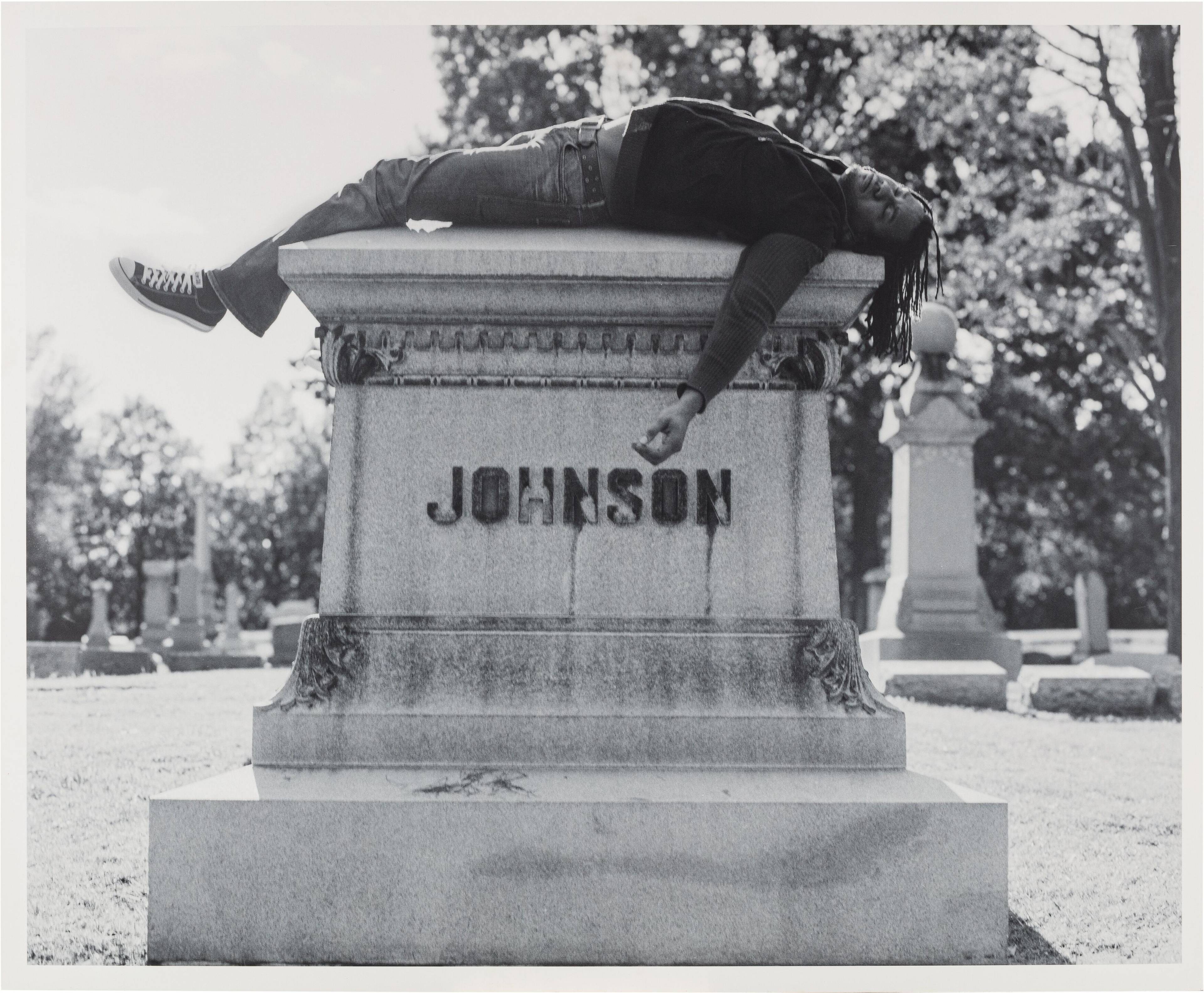
Rashid Johnson, Self Portrait laying on Jack Johnson's Grave, 2006, chromogenic print mounted on panel, 103 x 126 cm. © Rashid Johnson, 2025
From photos to paintings to videos, nearly every work spars casually with other legacies. What else can you do? These legacies are so, so heavy. Johnson makes a black and white photo of himself flopped across the pedestal of Jack Johnson’s gravestone, which is marked with their common surname (Self-Portrait Laying on Jack Johnson’s Grave, 2006). He’s apparently so floored by Baldwin’s The Fire Next Time (1963), a collection of essays on segregation for white readers, that he stacks ninety copies on a shelf in Untitled Microphone Sculpture (2018). The closest Johnson comes to self-parody is Contemporary Black Male Literature Starter Kit (2003–), a pallet of books thickly wrapped and obscured in plastic film, as if to reify the anxiety of influence: “See? My work is all citations! It’s all too much! Too much for one man to carry.”
In contrast to Johnson’s quiet confidence, the whole machine around him seems anxious to assert that he is a good, even great artist, an artist of our time. Ragging on wall labels is a low blow, but the texts for “A Poem for Deep Thinkers” try painfully hard to convey the depth of Johnson’s thinking, his reservoir of references, his grasp of material history. Two perfectly passable videos are said to be shot in the “Dogma” style – apparently a reference to the Dogme 95 film collective dedicated to raw production and untrained actors – although long, static takes have been a staple of video art since the 1960s. Another text observes that the nearby “large canvas supports multiple layers of oil paint,” as if this is at all remarkable. Maybe the most audacious label attends a pair of whitewashed child-sized sleds placed side by side on a pedestal (Homage to Chinua Achebe IV (Fela Kuti “Zombie”), 2004). One is whole, one is smashed – a chain of citations, it is written, of the Nigerian activist Funmilayo Ransome-Kuti (1900–1978); her son, the musician Fela Kuti (1938–1997); fellow Nigerian novelist Chinua Achebe (1930–2013); Western art heroes Marcel Duchamp (1887–1968) and Joseph Beuys (1921–1986). Ransome-Kuti was thrown from a window, Duchamp dropped one-meter long strings from a height of one meter, and Beuys used sleds in his personal myth. It is almost sarcastic, a game to see how ambivalent the artist can be, and how historic the museum can declare his work is. Truly, as the label says, “Johnson adopts what art historian Sampada Aranke terms a ‘citational’ approach.”
It makes me anxious that maybe this dance between archness and guilelessness is the whole point. Maybe Johnson’s work is boring, or repetitive and commercial, or overly reliant on references, for a reason.
It turns out that it’s tricky to engage Johnson’s work critically, not to say negatively. In her recent essay “Black Block,” published on Triple Canopy, scholar Rachel Hunter Himes writes that Black artists including Johnson (and painter Kehinde Wiley in particular) have reached art world heights on terms that avoid discussion of their art, in favor of biography and identity. “The work of black artists – and indigenous artists, other artists of color, and queer artists – has been asked to redeem audiences, institutions, and buyers, with its patronage, purchase, and display to serve as reparative gestures,” she writes. “This framework, which suggests that the consumption and assessment of black artists always carries political stakes, is not one that easily accommodates negative judgments.”
The way Johnson packs his work with references, and materials charged with Black life, seems to push the conversation away from his art, and away from criticism. This in the political sense Himes describes, as well as an entwined economic one. Where his study of Afrocentrism goes deep, its symbols sit on the surface, made legible to all. In 2008, when canny Los Angeles dealer David Kordansky decided it was time to add a Black artist to his program, he signed Rashid Johnson. Those “Anxious Men” paintings, which he’s been making for a decade, are reliable sellers. One hammered at Sotheby’s this fall for half a million. Rich and established folks get anxious too.
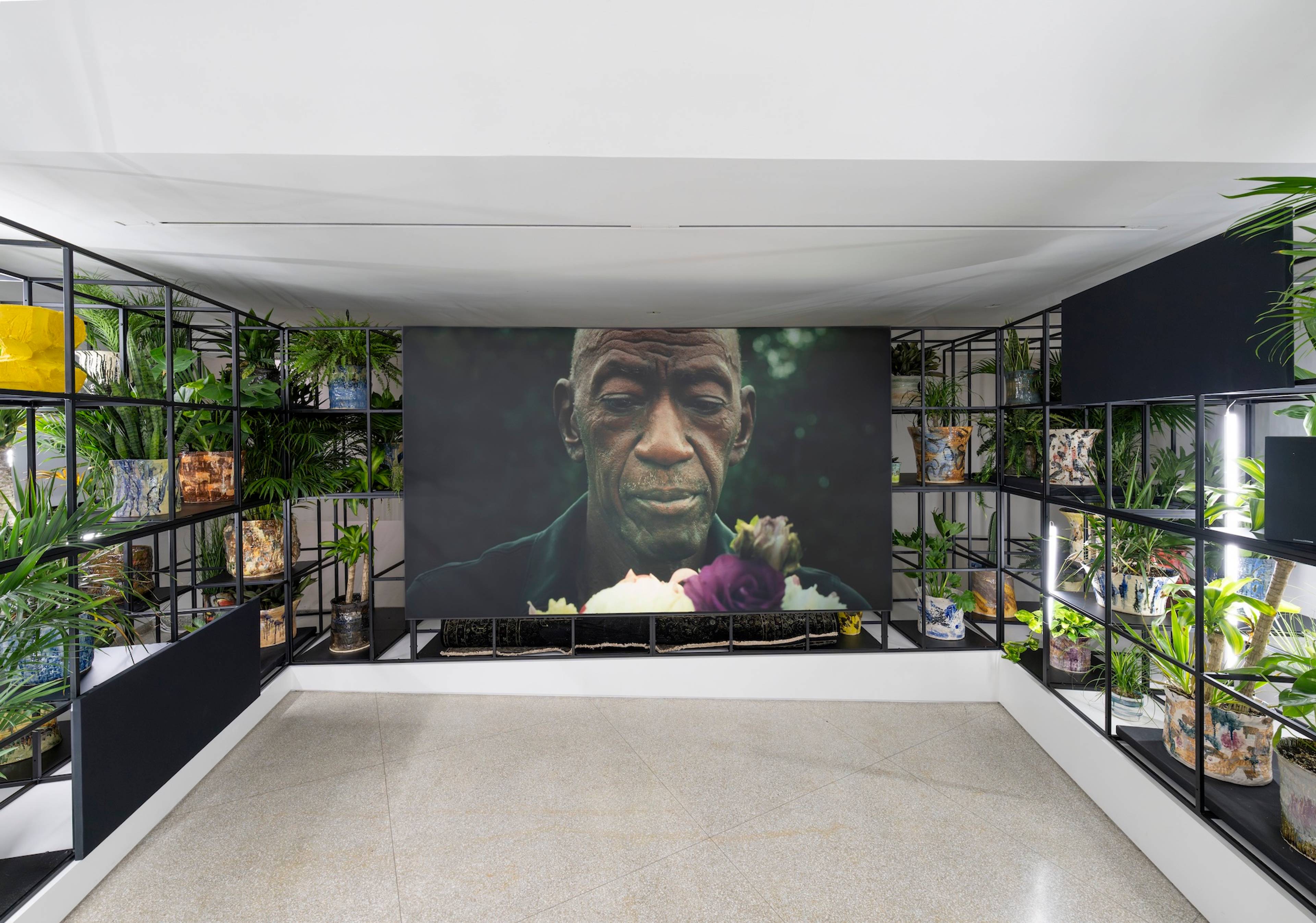
View of “Rashid Johnson: A Poem for Deep Thinkers,” 2025–26, Solomon. Guggenheim Museum, New York. © Solomon R. Guggenheim Foundation, New York. Photo: David Heald
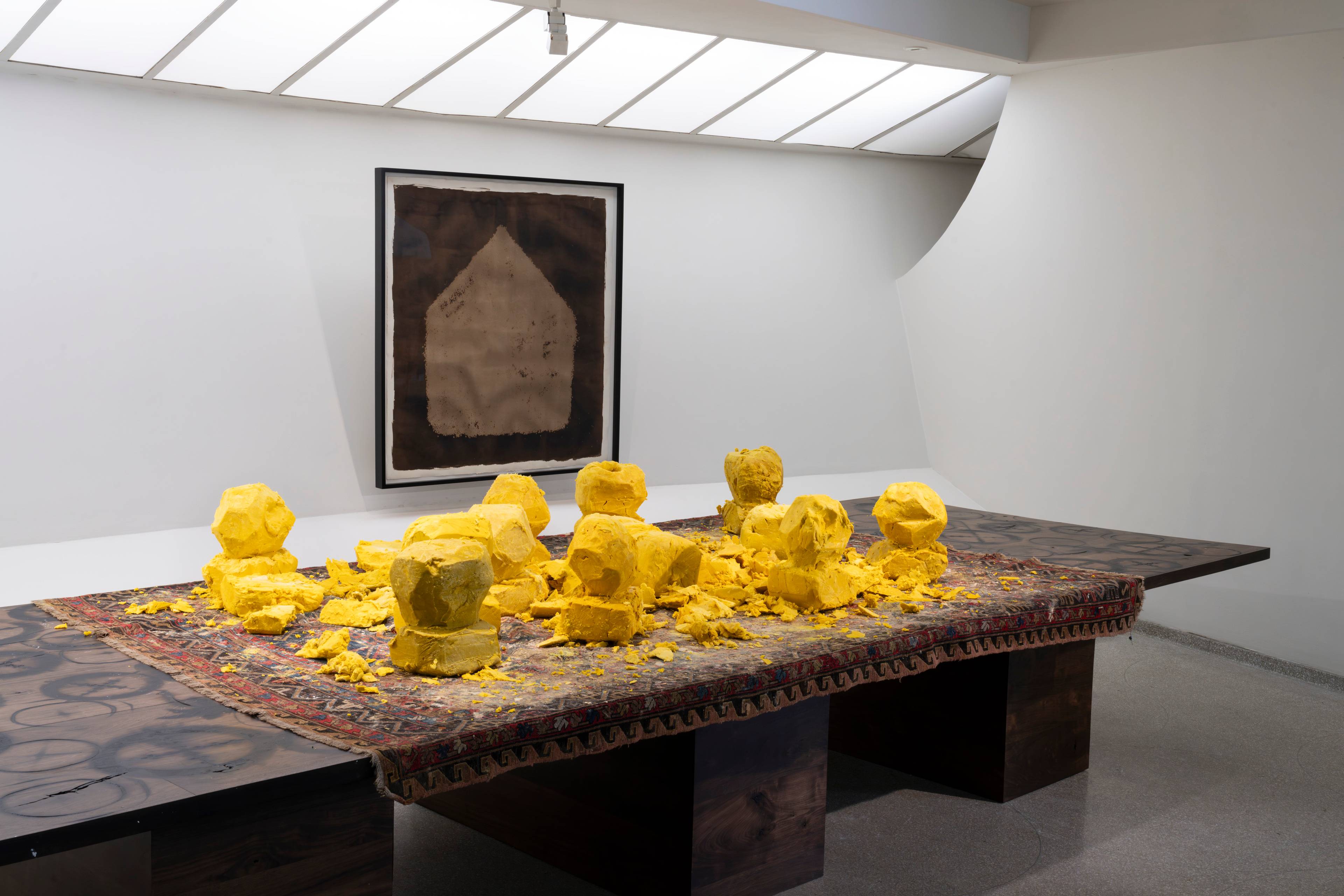
View of “Rashid Johnson: A Poem for Deep Thinkers,” 2025–26, Solomon. Guggenheim Museum, New York. © Solomon R. Guggenheim Foundation, New York. Photo: David Heald
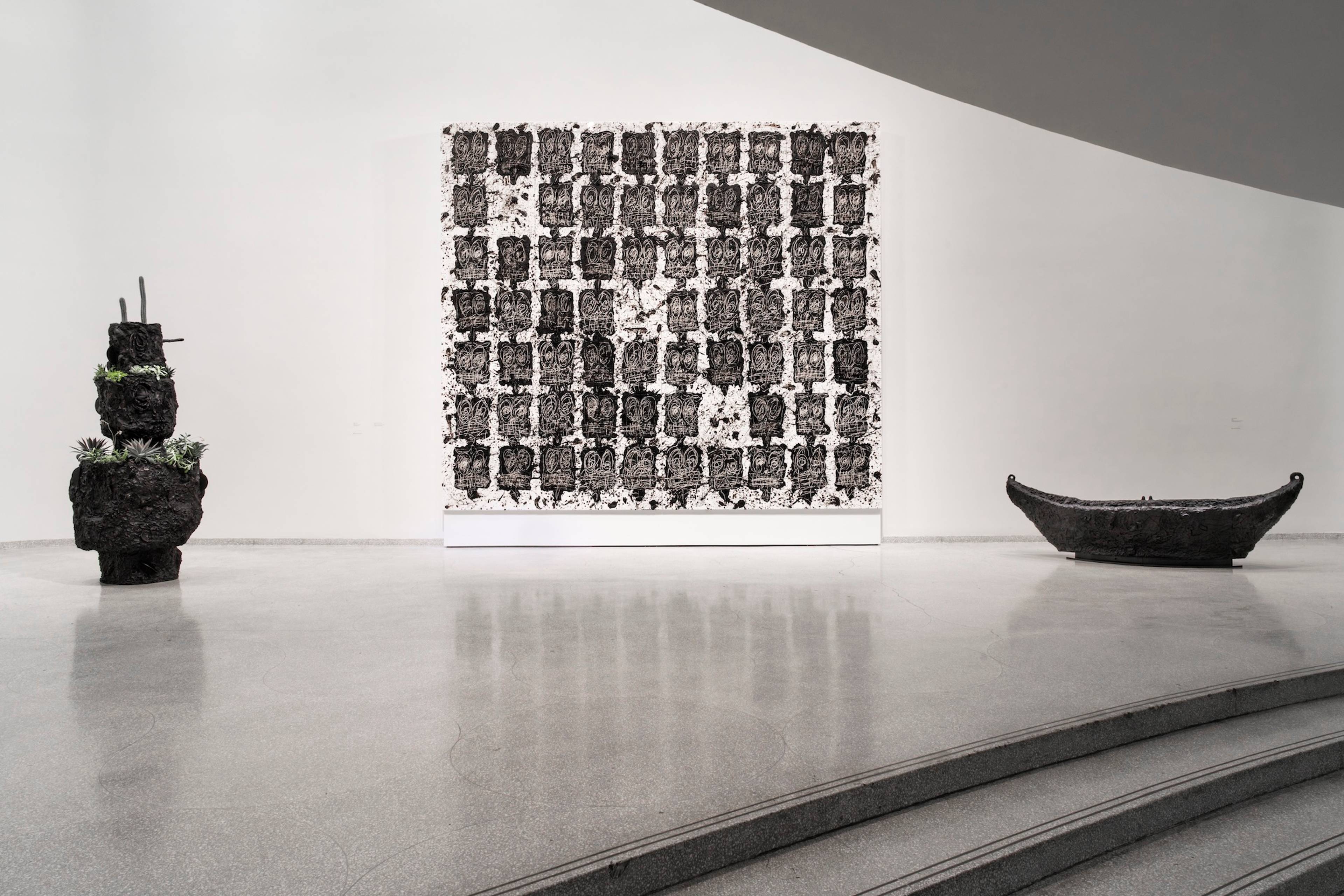
View of “Rashid Johnson: A Poem for Deep Thinkers,” 2025–26, Solomon. Guggenheim Museum, New York. © Solomon R. Guggenheim Foundation, New York. Photo: David Heald
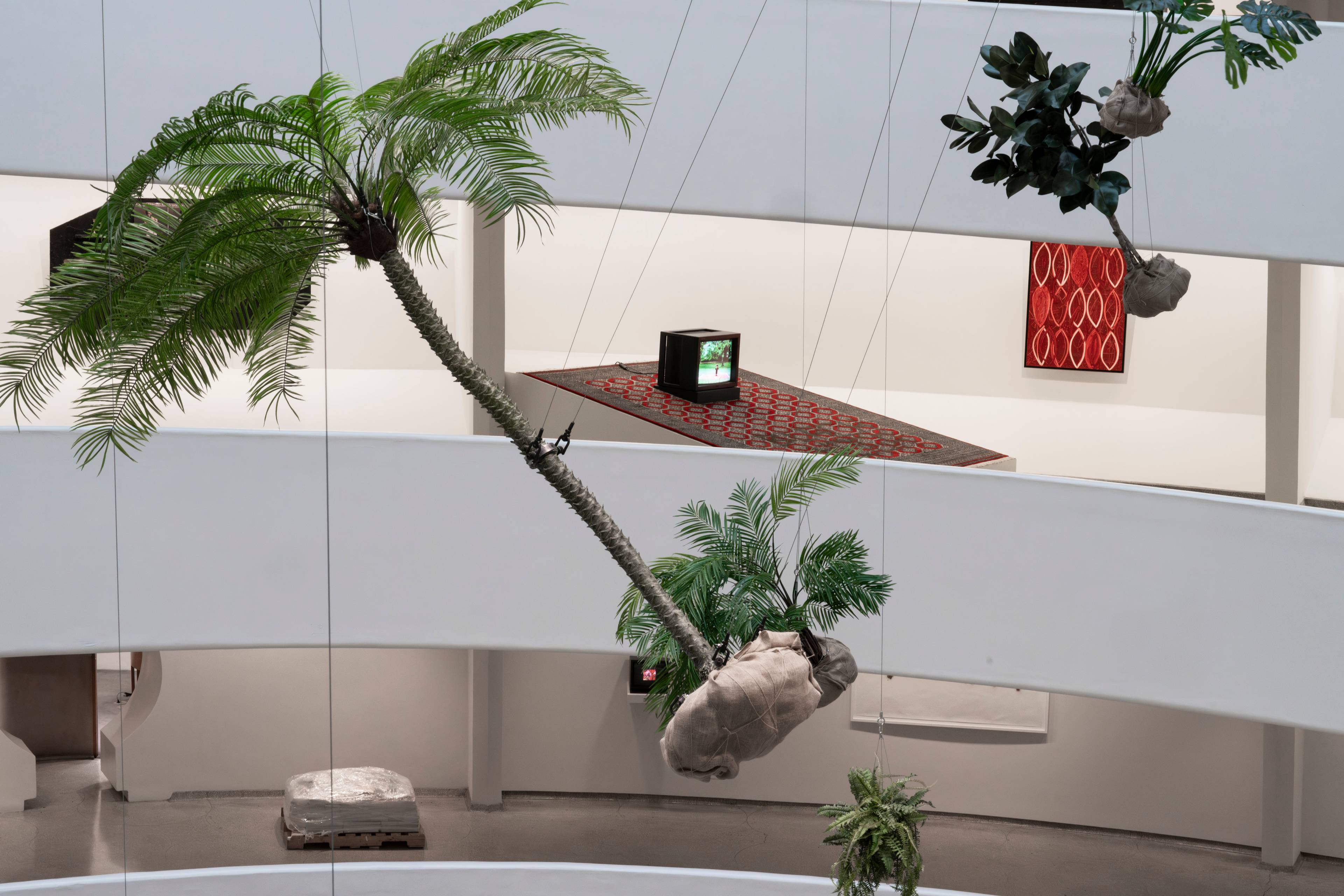
When it closes in January, “A Poem for Deep Thinkers” will have been on view for nine months – longer than both previous Guggenheim headliners combined. Call it a recession indicator. The show persists, as if to reassure everyone invested psychically, politically, or financially in Rashid Johnson that they made a good choice. But that Dogme-like duration is having the opposite effect. The declaration that the show is a “Poem for Deep Thinkers” (the title – guess – quotes a 1977 poem by Black writer and political activist Amiri Baraka) is hard to sustain for very long. Johnson accents the Guggenheim’s central skylight with a couple dozen plastic houseplants dangling from cables, down into the spiral. Fine, some harmless atmosphere, if you don’t think about it. At first, I assumed they were alive. But of course they couldn’t be, they remained perfectly green into the show’s final month, and the museum probably doesn’t have the budget for aerial groundskeepers. Think about it, and those plants seem like a way to nervously fill that famous space, as if the art itself isn’t enough.
The show hides behind the idea of poetry: If you don’t like it, you must not think that deep. Which reprises the elitism and pretentiousness audiences find in the art industry. It makes me anxious that maybe this dance between archness and guilelessness is the whole point. Maybe Johnson’s work is boring, or repetitive and commercial, or overly reliant on references, for a reason. You could imagine the show as a cosmic prank designed to intervene in a contemporary art system that uses arcane history to guard its borders while also selling tickets to a general audience and laundering various guilt through philanthropy. In that sense, it’s a raw self-portrait by an artist at the top. The paranoid drive to interpret art’s visual texts makes “A Poem for Deep Thinkers” a panegyric to anxiety. Even the Baraka riff is a joke: in the poem, humans on the ground think the “skymen” are dancing with joy, but they’re really flailing, blinded by the sun.