

There’s much to recommend “Monuments” at MOCA Geffen in Los Angeles, a show of toppled tributes to the Confederacy – those Southern states that split from the Union in the 19th-century US Civil War to preserve slavery – intermingled with contemporary art. Critics agree it’s refreshing to see a show with real historical gravity and scope, one that frames today’s convulsions toward justice as part of a generational struggle. Statues go up, statues come down. I had high hopes “Monuments” would rise to the political moment, what sometimes feels like the eve of Civil War II. I was disappointed. Walking among all the patinated, graffitied bronze horse butts and angel robes dedicated to bigoted Americans now sequestered in a Frank Gehry-renovated art museum, the ambitious show’s limits felt plain. Contemporary art, by definition, addresses itself to the present moment. But the Confederate monuments dethroned in the recent decade’s anti-racist uprisings and dragged into that context address themselves to eternity. Sometimes they literally appeal to heaven. On God’s judgment day, these statues claim, those Confederate pariahs, unjustly condemned as traitors and racists, will be welcomed home.
This is the real monument. No statue, no object, but myth. Some call the Confederacy the Lost Cause: It is established fact – these folks wrote it down – that the rebel cause was Black slavery, yet the pervasive monument of the Lost Cause as something doomed and noble is so vast and insistent that it overwhelms the truth. I grew up in the American South; many otherwise reasonable and gentle people in my life unquestioningly accepted that the Civil War was a principled defense of God-given liberty, state’s rights, and heritage. (And of slavery? Oh, that too, I guess.) One wall label at MOCA echoed that experience. US artist-activist Hank Willis Thomas, it said, with his grandmother and his mother (Deborah Willis, a MacArthur fellow) – a worldly Black family – enjoyed Dukes of Hazzard, an early-80s TV program starring two handsome hillbillies and their Confederate Flag-liveried muscle car. They never discussed its Lost Cause overtones.
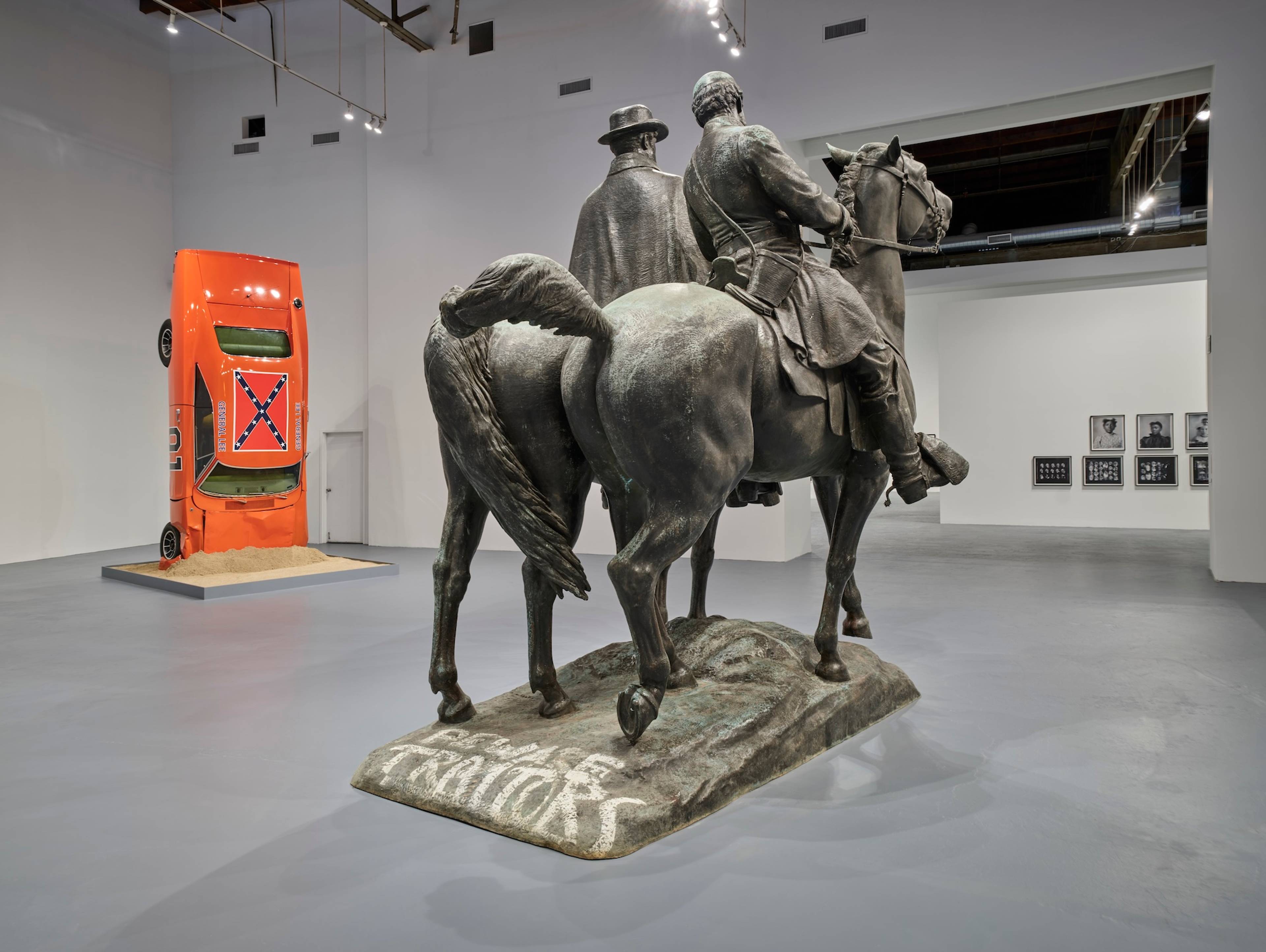
View of “Monuments,” 2026, The Geffen Contemporary at MOCA, Los Angeles. Courtesy: The Museum of Contemporary Art (MOCA) and The Brick. Photo: Fredrik Nilsen
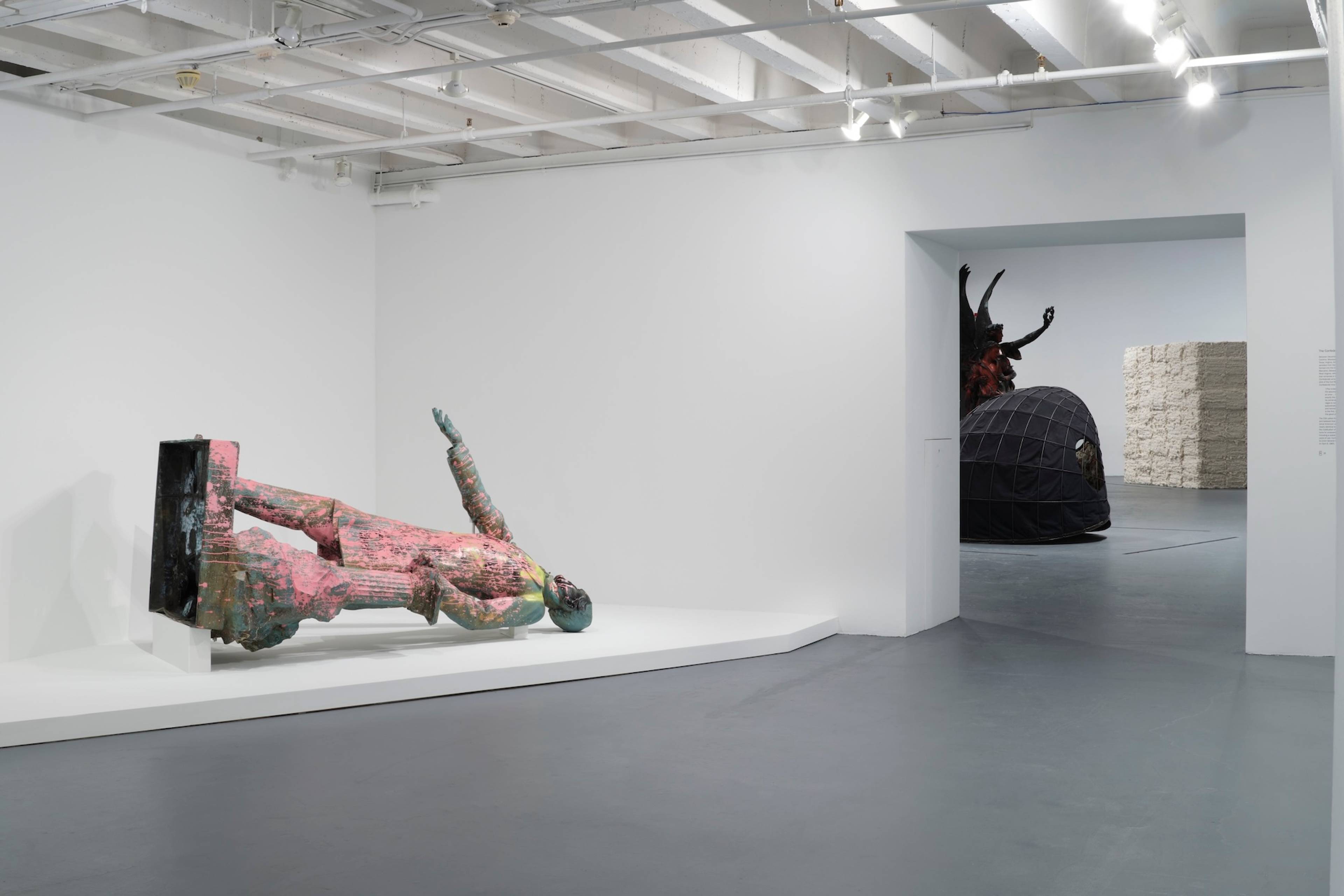
View of “Monuments,” 2026, The Geffen Contemporary at MOCA, Los Angeles. Courtesy: The Museum of Contemporary Art (MOCA) and The Brick. Photo: Fredrik Nilsen
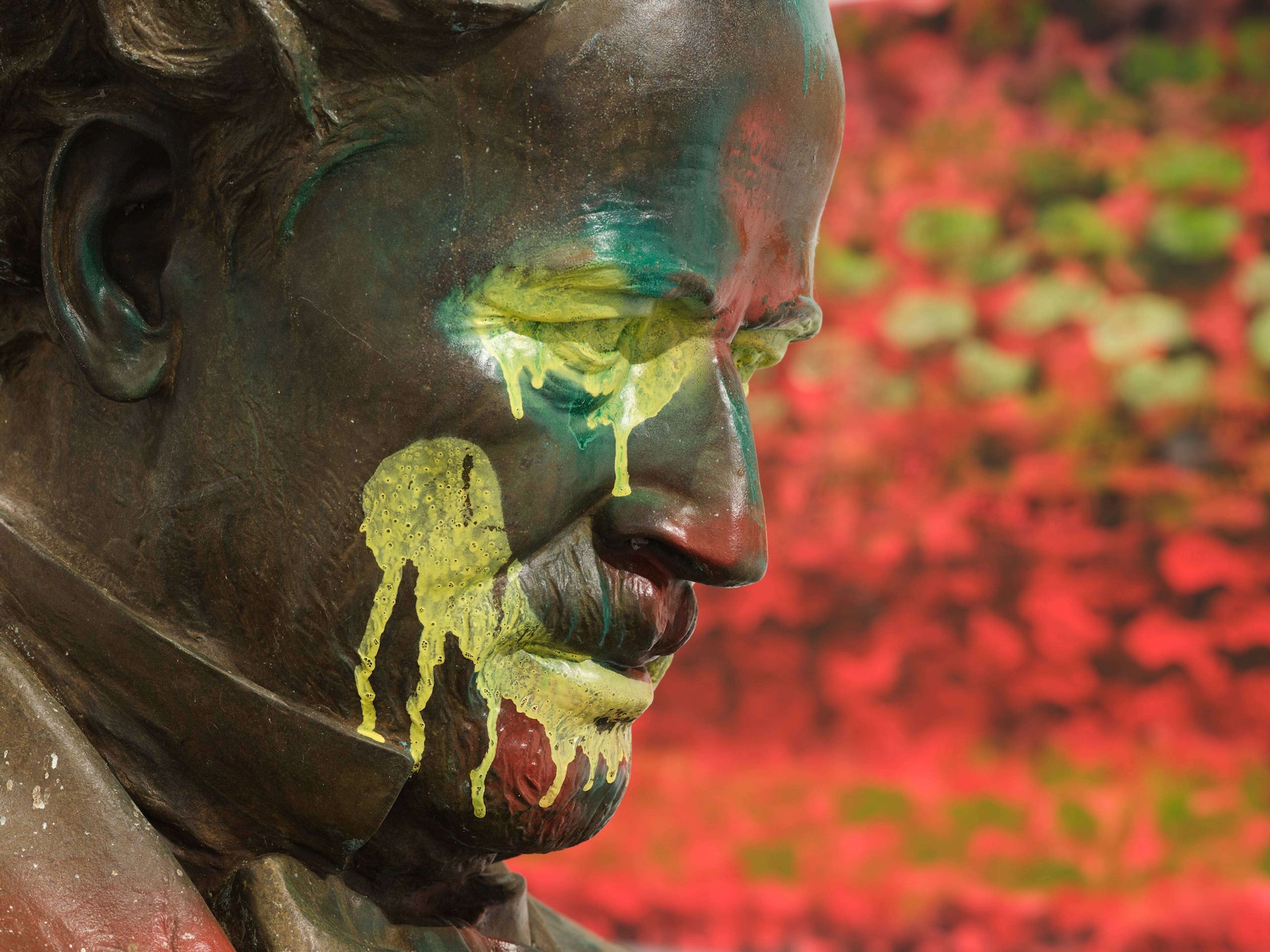
Frederick William Sievers, Matthew Fontaine Maury (detail), 1929, bronze, 230 x 160 x 168 cm. Installation view, “Monuments,” 2026, The Geffen Contemporary at MOCA, Los Angeles. Courtesy: The Museum of Contemporary Art (MOCA) and The Brick. Photo: Fredrik Nilsen
Unfortunately, the related Thomas sculpture (A Suspension of Hostilities, 2019) is a study in inadequacy. In the show’s back corner, sharing space with a mammoth equestrian figure group from 1948 depicting Generals Robert E. Lee and Stonewall Jackson, contemporary art offers: A replica Dukes of Hazzard car, cherry red flag face out, stuck nose-down in a shallow tray of sand. Maybe it’s petty, but the way the sand has been pushed into mounds around the tires in a par-baked attempt to make the car look “buried” is a great metaphor for the sculpture’s lack of depth. The battle flag and orange Dodge Charger car scream that racism refuses to disappear, but we know that, or we wouldn’t be viewing this show. In 100 years, the work’s personal, pop symbolism will make no sense outside an academic unpacking of 21st-century material culture. It barely moves the needle now. “Monuments” sees the myth, even names it – but there’s something about contemporary art that throttles any adequate response to the monument itself, which is temporal, immaterial, and pervasive.
What’s missing is contemporary art that addresses itself to eternity. But Contemporary Art, as a genre and periodization of art history, fixates on the present by definition. You could cut this several ways – market, media, audience. The obvious one first: today’s artists, by and large, are business people; they make products, which they need to sell quickly, in order to buy materials and (often) to survive. They’re not thinking about Judgment Day, just September. As for media, the physical nature of much contemporary work sacrifices long-term stability for the latest tech. Conservators work tirelessly to preserve electronics, plastics, photographs, and data from fade and rot. But the overarching problem is address. Contemporary art necessarily addresses itself to the present moment, which means appealing to a coterie of people invested in having that conversation in art’s language. This also rewards fast turnaround and fads.
Contemporary art is mostly agnostic, but it believes in itself – heaven is art history.
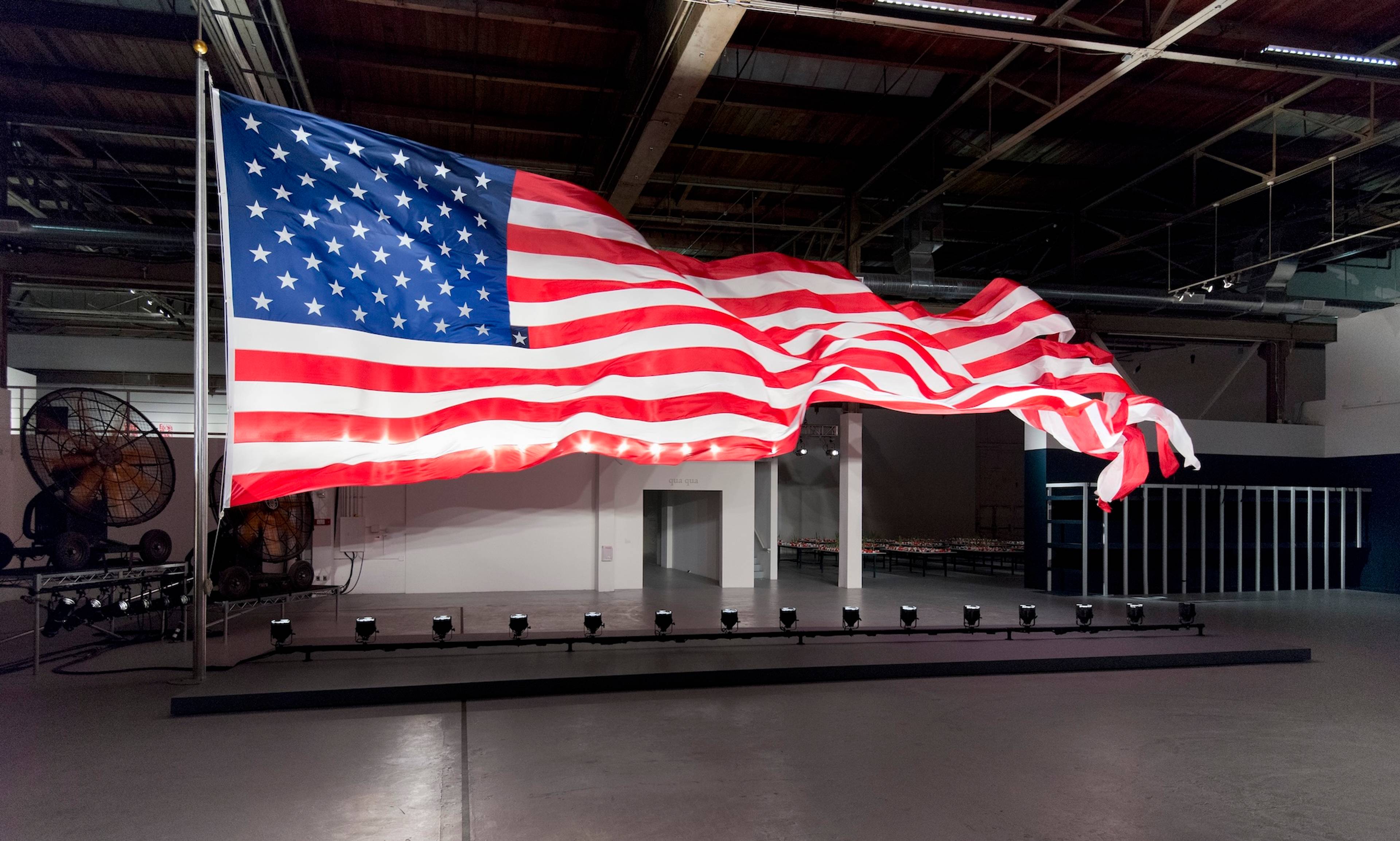
But, you’ll say, those racist statues, some only fifty years old, were also addressed to their presents. Yes, that’s the limited sense in which it’s possible to judge them on contemporary art’s terms. But they also address the far future, by perpetuating a legend. That’s what makes a contemporary monument. One art world example springs to mind – a 2015 survey of Pope.L at the selfsame MOCA Geffen. The main gallery was taken up by the bombastic, satirical Trinket (2008/2015), an American flag of unholy size both held aloft and whipped to shreds by powerful fans. A Pope.L video in that same show, titled Reenactor (2012), is more subtle – a surreal, hours-long atmospheric treatise with, as I remember it, no dialogue, just children dressed in gray Confederate uniforms and false beards meandering through Nashville. Why this town? It’s the home of easily the best Confederate neo-monument, a manic depiction of a calvary officer raising sword and pistol and grimacing that looks like it hasn’t fully rendered, built of polyurethane coated in metallic shades of copper and blue. Pope.L’s video (which, to the point, “Monuments” curator Hamza Walker and his team are screening this weekend in LA) depicts the pervasive and insane Southern monument as something that transcends statues, more like a racist humidity. Trinket is his take on a statue plugged into a similar national myth.
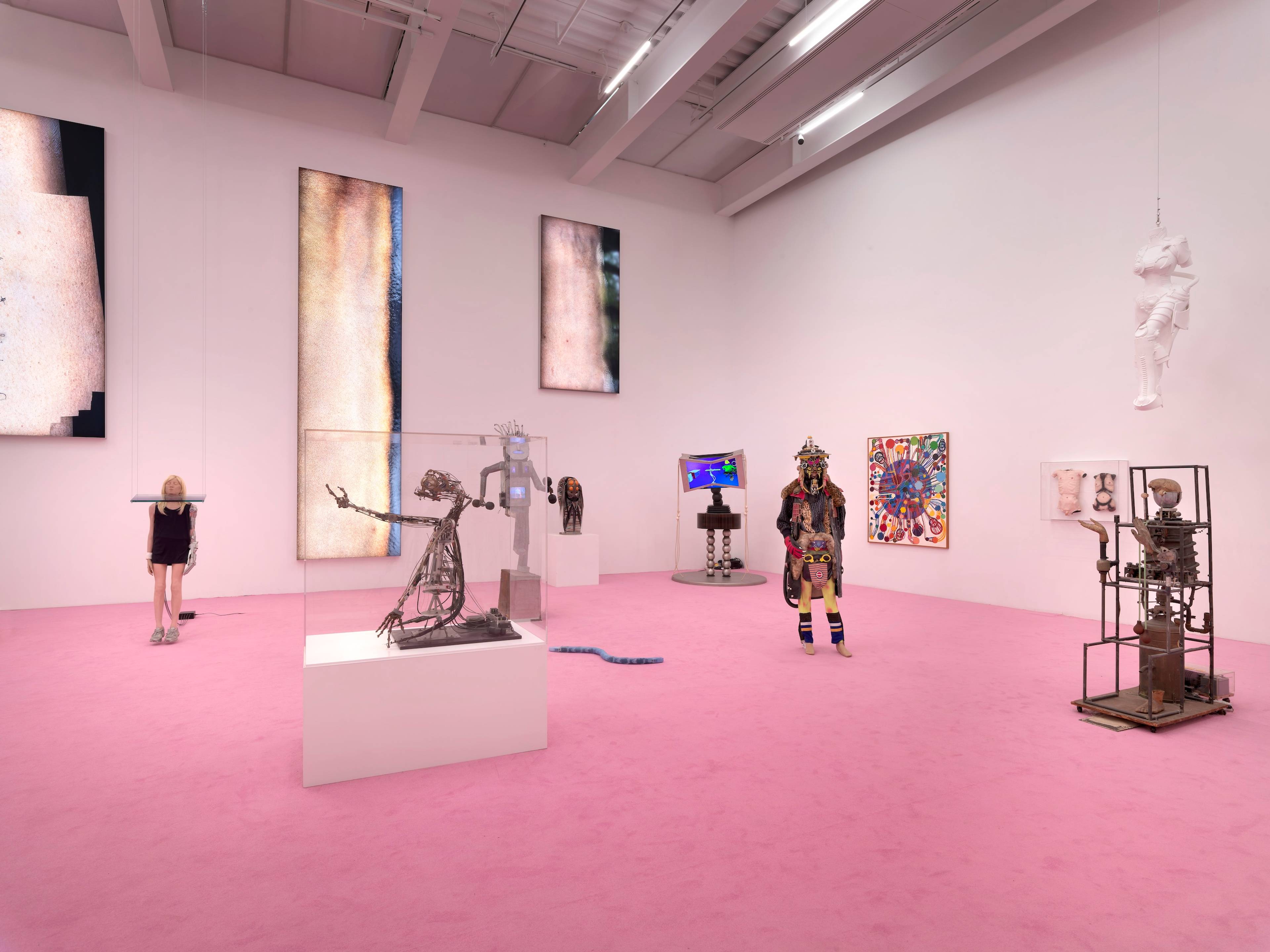
View of “New Humans: Memories of the Future,” 2026, New Museum, New York. Courtesy: New Museum. Photo: Dario Lasagni
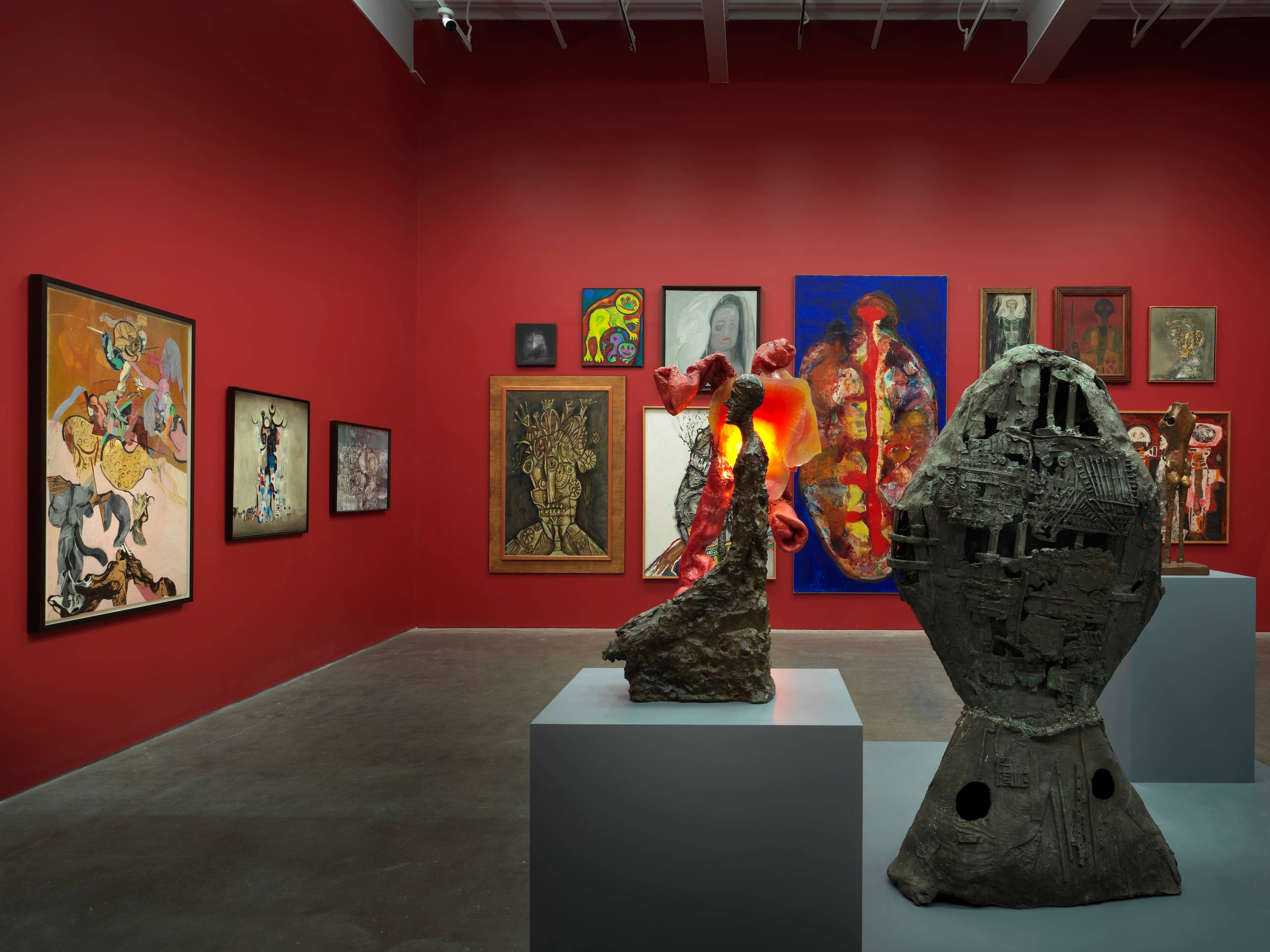
View of “New Humans: Memories of the Future,” 2026, New Museum, New York. Courtesy: New Museum. Photo: Dario Lasagni
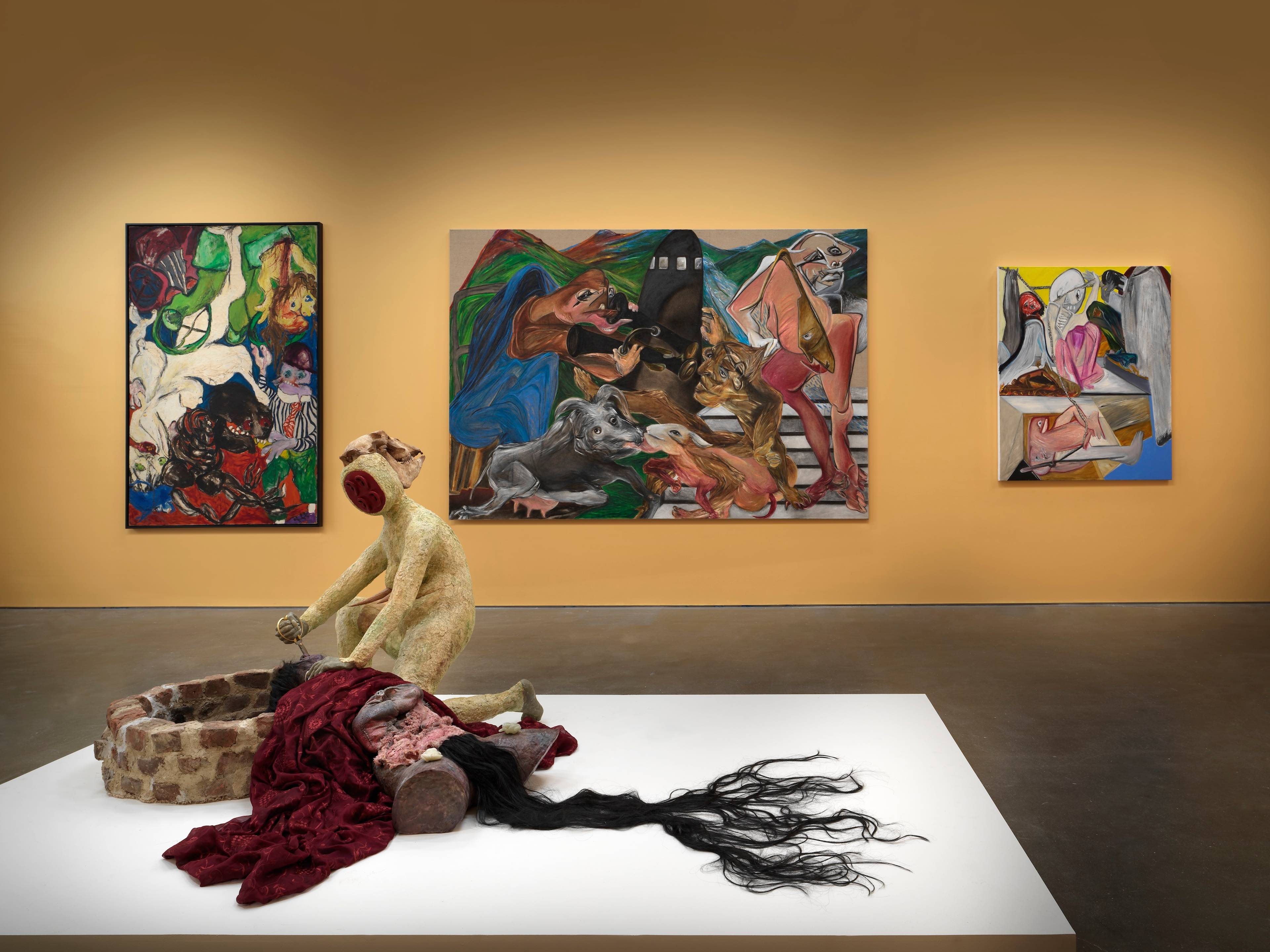
View of “New Humans: Memories of the Future,” 2026, New Museum, New York. Courtesy: New Museum. Photo: Dario Lasagni
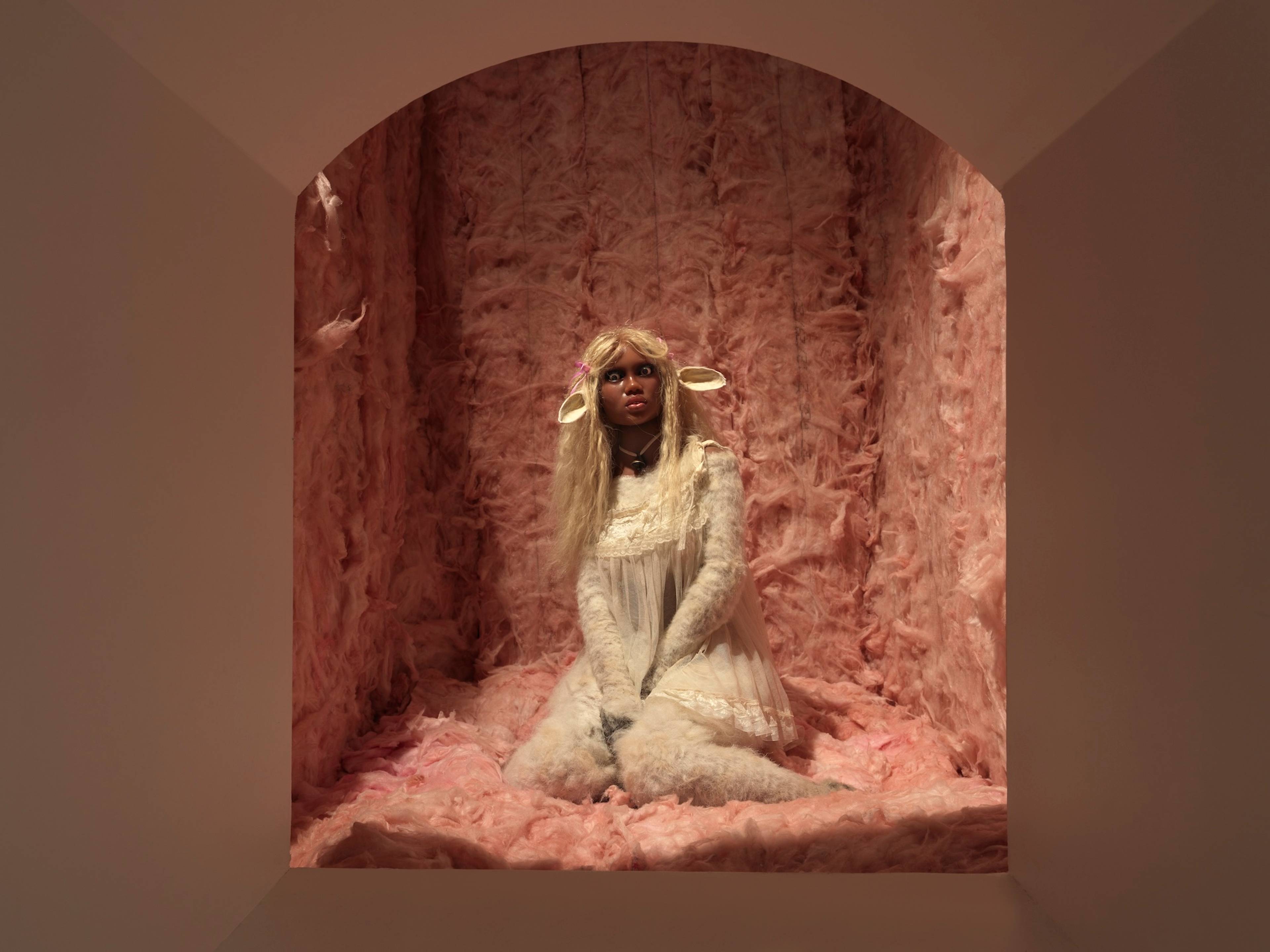
Precious Okoyomon, When the Lambs Rise Up Against the Bird of Prey, 2024. Silicone, stainless steel, wool, fabric, artificial hair, and animatronics, 116 x 86 x 62 cm. Courtesy: Collection Patrizia Sandretto Re Rebaudengo. © Precious Okoyomon. Photo: Dario Lasagni
The thing about the Confederates, like many far-right ideologues, is that they hold strong beliefs. What does contemporary art believe in? One answer is Humanism. Last week, the hectic extravaganza of “New Humans: Memories of the Future,” the inaugural show curated by Massimiliano Gioni for the New Museum’s fresh expansion, finally opened. It’s dense, nuanced, and cocky: worth pondering from many angles. The broad themes of the last few years are there – the posthuman, the cyborgian, the autonomous – but from the outside, it’s not obvious how historically-minded the survey is. The checklist covers 113 years, from Jacob Epstein’s bronze The Rock Drill (1913–14), a cubist-ish bust of a droidlike miner, to a 2025/2026 group of mushy magenta and green portrait paintings wriggling with roots and leaves by Kenyan artist Wangechi Mutu. There’s a robots-and-aliens room with pink carpet, an overhung salon of abject modernism and art brut, a blue hallway with work about computers, terminals, math, and mechanical brains. Little here looks futuristic – instead, the work recalls past futurisms, imagined by artists confined to their respective presents. It’s a good argument for retiring the idea that contemporary art has predictive power. Pierre Huyghe’s celebrated video of a monkey in a smooth, pale human mask, picking through an irradiated, post-anthropocine ruin, feels very much like the cutting edge of 2014 (and probably the peak of Huyghe’s practice); on the other hand, monkeys are forever. A 2025 installation by Hito Steyerl, Mechanical Kurds, puns on the chess-playing mechanical Turk from the late-18th century, which is also cynically the namesake of Amazon’s task platform that offers dehumanizing clickwork for pennies an hour. The Kurds in Steyerl’s video help train AI, and maybe, up the chain, contribute to the killer drones used to hunt Kurds. This isn’t prophecy, it’s documentary, and it feels both obsolesced and topical – a contemporary feeling, of being ground down by history.
Who will tell our tale? “New Humans,” much like “Monuments,” demonstrates the importance of institutional stewardship. The vast majority of artworks are headed for the hell of obscurity – yet, on some level, artists have faith that their work will be seen, discussed, preserved. Contemporary art is mostly agnostic, but it believes in itself – heaven is art history. Sorry, neo-modernists, you can’t have autonomous objects. Big-P Painting is meaningless without its surrounding discourse, as adrift as early computer art without Rhizome or a Confederate monument without white supremacy. All this stuff only reaches eternity insofar as its audience carries it there. Those are the stakes.