
The first thing one might see upon stepping off the train at Venezia Santa Lucia is a poster for “Helter Skelter: Arthur Jafa and Richard Prince” at Fondazione Prada, its images cropped to fit the poster’s proportions. Anyone familiar with the artists’ use of appropriation can appreciate the irony – even the appropriateness – of encountering their work already reframed by the demands of reproduction. It is a fitting prologue, in that, to an exhibition of stolen, cropped, perforated, repainted and projected images, alongside a few sculptures – assembled from tires, car parts, and aluminum cutouts – that extend the same logic into three dimensions.
Curator Nancy Spector brings Jafa (*1960) and Prince (*1949) together for the first time around this shared method and a shared symbolic territory: the vast American imaginary. Yet, they diverge over what lies at its heart, whether a pulse or an abyss, as well as over what to do with it. “Helter Skelter” stages an American vernacular of projected images, glossy photographs, and industrial materials against ornate palazzo interiors, with its crooked beams and sloping parquets, through a succession of room-by-room encounters built around thematic and formal rhymes. The exhibition becomes compelling, however, when those symmetries break down and the same gesture produces different ethical, emotional, and political effects depending on the body, history, and position of the artist who performs it.
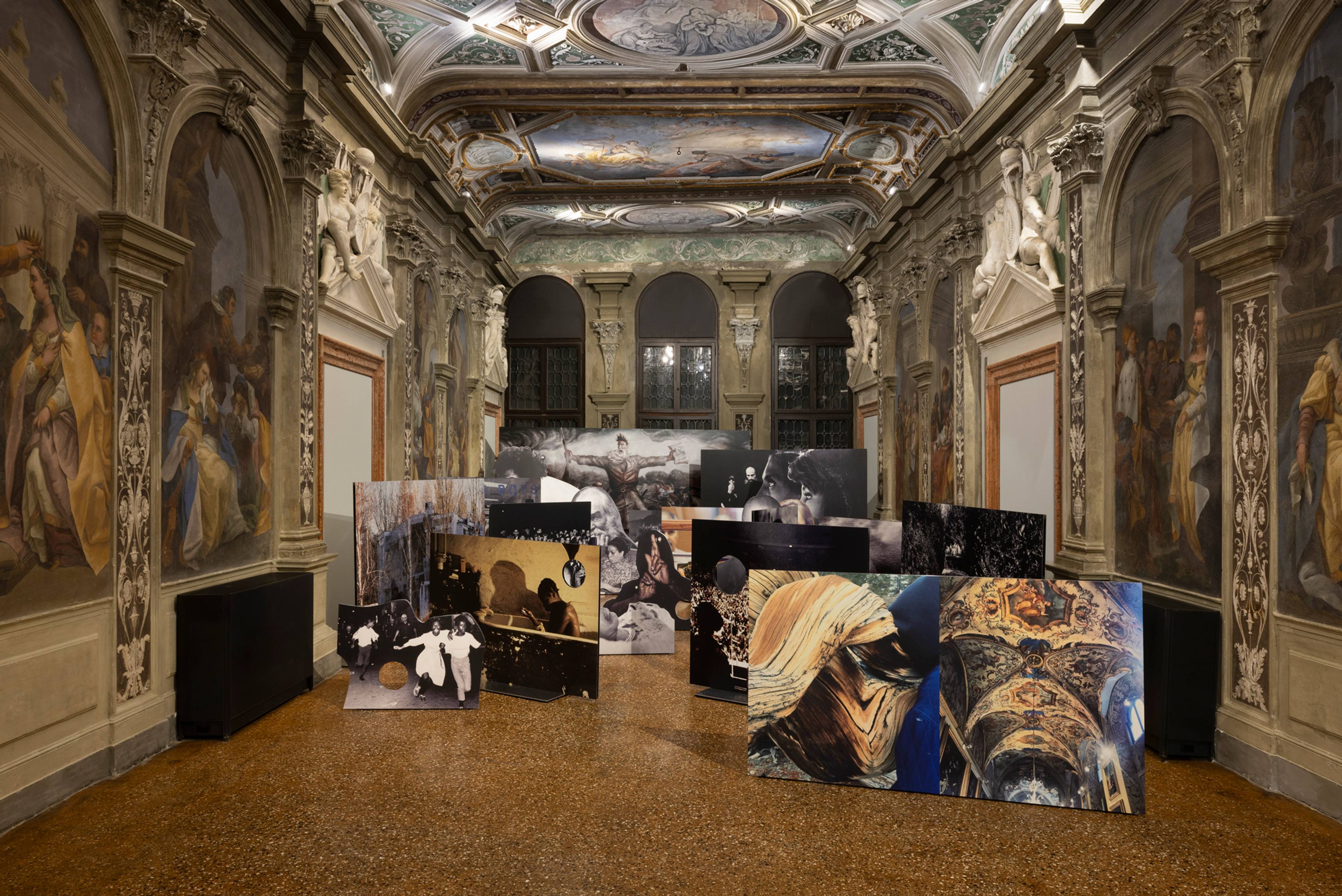
One such face-off plays out in the 18th-century salon. In Viriconium (2026), Jafa arranges aluminum cutouts of figures, ranging from Malcolm X to Walt Whitman, into a composite self-portrait, spilling haphazardly from the walls like cheapified frescoes. Facing it are Prince’s The Entertainers (1982–83): large-format photographs of aspiring actresses encountered in Times Square dive bars and movie theaters, haunts where dreams of show-business stardom often ended in commercials or porn. Both works concern self-representation; but where Jafa constructs his own image through a collective pantheon, Prince examines his subjects’ attempts to fashion themselves for public recognition, only to leave them hanging in the hollow promise of fame, face-ful but nameless.
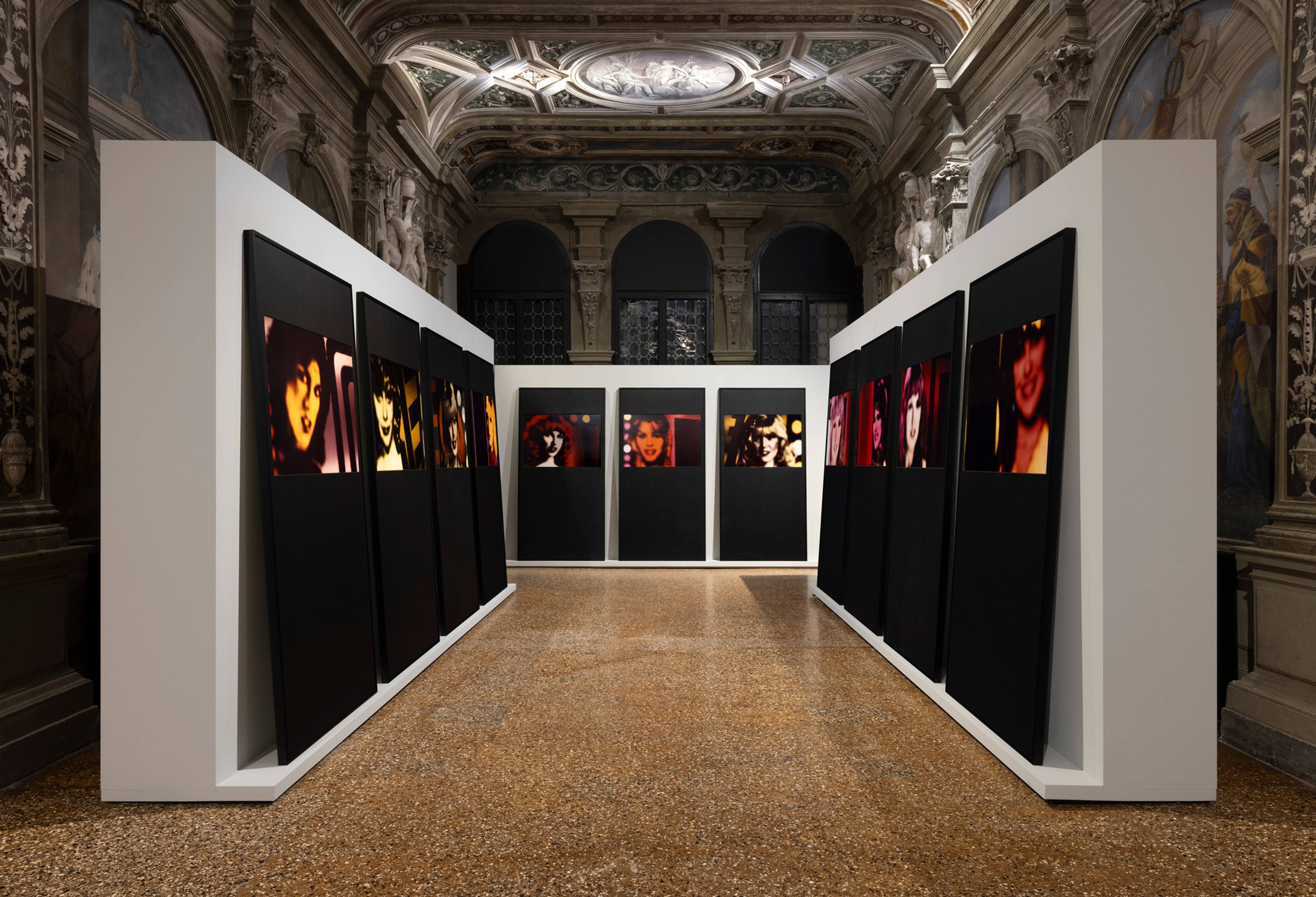
Richard Prince, The Entertainers, 1982–83
Elsewhere, Jafa’s The White Album (2018) combines found and original footage to observe whiteness from a Black perspective. The film cuts from tender close-ups of Jafa’s white friends and colleagues to video of Dylann Roof entering the Charleston, South Carolina church where, in 2015, he would murder nine Black worshippers and Honey Boo Boo, a child celebrity accused of appropriating a Black affect, insisting that “you can’t act a color,” keeping intimacy in uneasy proximity to white supremacism and comic absurdity. “Like many of my best ideas, [it] started as a joke,” the artist says – until, that is, a friend told him: “This is something huge. White folks are going to love it.” So much so that, shown at the 58th Venice Biennale (2019), it won him the Golden Lion. The video is surrounded by three text-based works by Prince (I Know This Guy, 1980; Untitled, 1990; Future, 1992) their crude one-liners obscured beneath layers of paint; “I eat politics and I sleep politics but I ne …” reads the tamest of them. Jafa expands a joke into an electrifying political compendium; Prince drains it of any humor or purpose, scraping it down to its sordid skeleton.
The contrast comes to a head in the exhibition’s best-known works. Love Is The Message, The Message Is Death (2016) condenses a century of Black tragedy and glory – police brutality, President Obama singing “Amazing Grace” (1779) after that Charleston massacre, LeBron James in flight – into a seven-and-a-half-minute montage drawn from films, broadcasts, online clips, and Jafa’s own family footage, set to Kanye West’s gospel-rap. Muscular, spine-shivering art, it unsurprisingly drew both lines and tears when it premiered in 2016 at Gavin Brown’s Enterprise, New York, four days after Donald Trump was first elected president, catapulting Jafa to art-world stardom. Beside this immediate and utterly contemporary blockbuster, Prince’s three Untitled (Girlfriend) works (all 1993) seem to arrest time. In images rephotographed from motorcycle magazines, the young women meet our gaze as they once met readers’. Prince dissects these low-rent relics of male subculture with an indecipherable mixture of sarcasm, tenderness, and fetishism; yet, the awkwardness of their best efforts at smirks and pin-up poses makes them appear vulnerable rather than self-possessed, exposed twice over – first by the photographers, then by the rephotographer – and above all remote: as timeless as the ladies in 17th-century court portraits, with their codified bearing and mannered distance.
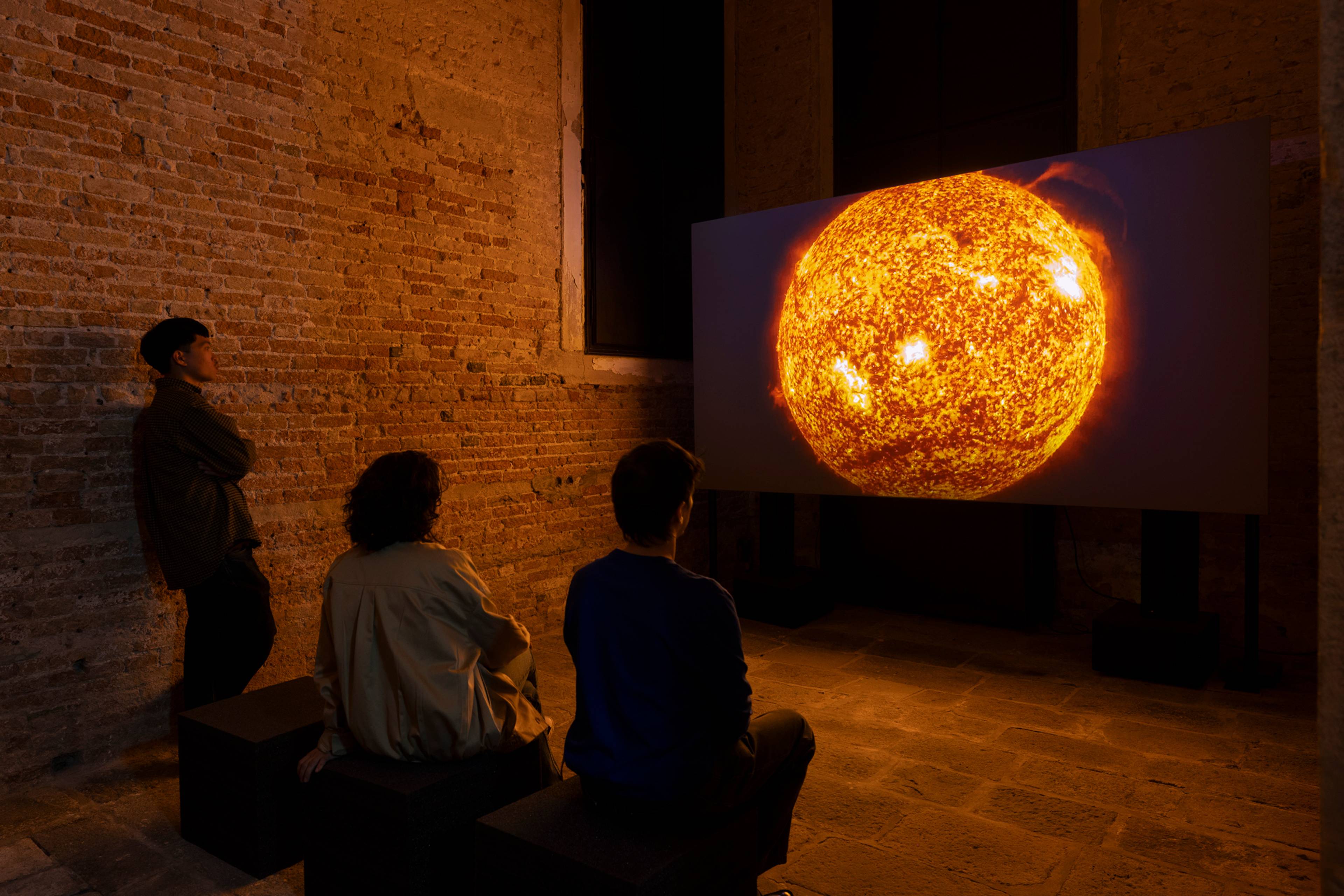
Arthur Jafa, Love Is The Message, The Message Is Death, 2016
Like a clerk following protocol without regard for the consequences, Prince removes a caption, isolates a detail, and recirculates the image, allowing it to implicate itself, the artist, and we the viewers. For, in exposing the objectifying violence in the biker magazine’s visual grammar, isn’t Prince also perpetuating it? His refusal to settle the question is as much his moral alibi as it is his artistic strength. This irritating reticence about the desire and judgment behind his seductive bad taste – “too good to be true,” as he puts it – is a deliberate choice to keep both illegible. Jafa, by contrast, adopts a musical posture: his “Black visual intonation” treats montage, both cinematic and spatial, as rhythm and repetition, but also as pressure to recompose images that, while not anonymous, do lack a shared subject, into a first-person plural. Drawn from the everyday realities of Black joy and trauma, Jafa’s imagery is anything but too good to be true.
The distance between these postures is political before it is moral or formal. Whereas Prince steals as though mass culture belonged to no one, or property itself were a joke, Jafa works within a history wherein Black culture has been endlessly appropriated, whose makers themselves were once propertized. By reinserting an image stripped of context by mass circulation back into a current of Black culture, Jafa can recast appropriation as an act either of preservation or of reclamation – a far cry from Prince’s piracy, which severs images’ ties to their subjects and history. Through other people’s images, Jafa constructs his own historical autobiography; Prince reduces himself to an archetype shaped by the images that bombard him and us alike, a form of autobiographical sabotage that makes identification as inevitable as it is unsettling.

Richard Prince, Untitled (Girlfriend), 1993
Jafa knows Prince’s work intimately, calling him a “fucking living legend” and “the blackest white artist” for having “authorized a certain … transposition of things from one space to another space as a legitimate … conceptual gesture.” Without Prince, Jafa’s work could not exist in its present form; but by giving Prince’s cold, procedural method a political charge, Jafa makes his appropriation of appropriation an incandescent gesture no less radical than Prince’s own.
Yet, that very incandescence raises the question of duration: how hot something burns may limit how long it can keep burning. Ten years later, Love Is The Message has lost none of its force; but a work built around so precise an arc of pathos may remain bound to the response it orchestrates, enduring principally as a capsule of its moment. Jafa moves us, but also prescribes how to react – precisely what Prince makes difficult. As Prince once said of art: “There’s no umpire; there’s no judge. There are no rules. It’s one of its problems. But it’s also one of the great things about art. It becomes a question of what lasts.” Some songs of mourning remain urgent and painful as they cross the centuries; Love Is The Message may be one of them. But Jafa’s song must keep hurting to endure, while Prince’s clichés and bad jokes, so long as the world they encode persists, and remains ours, need only keep circulating: having no urgency to begin with, they have none to lose.

Richard Prince, Untitled (Sunsets), 1981–82
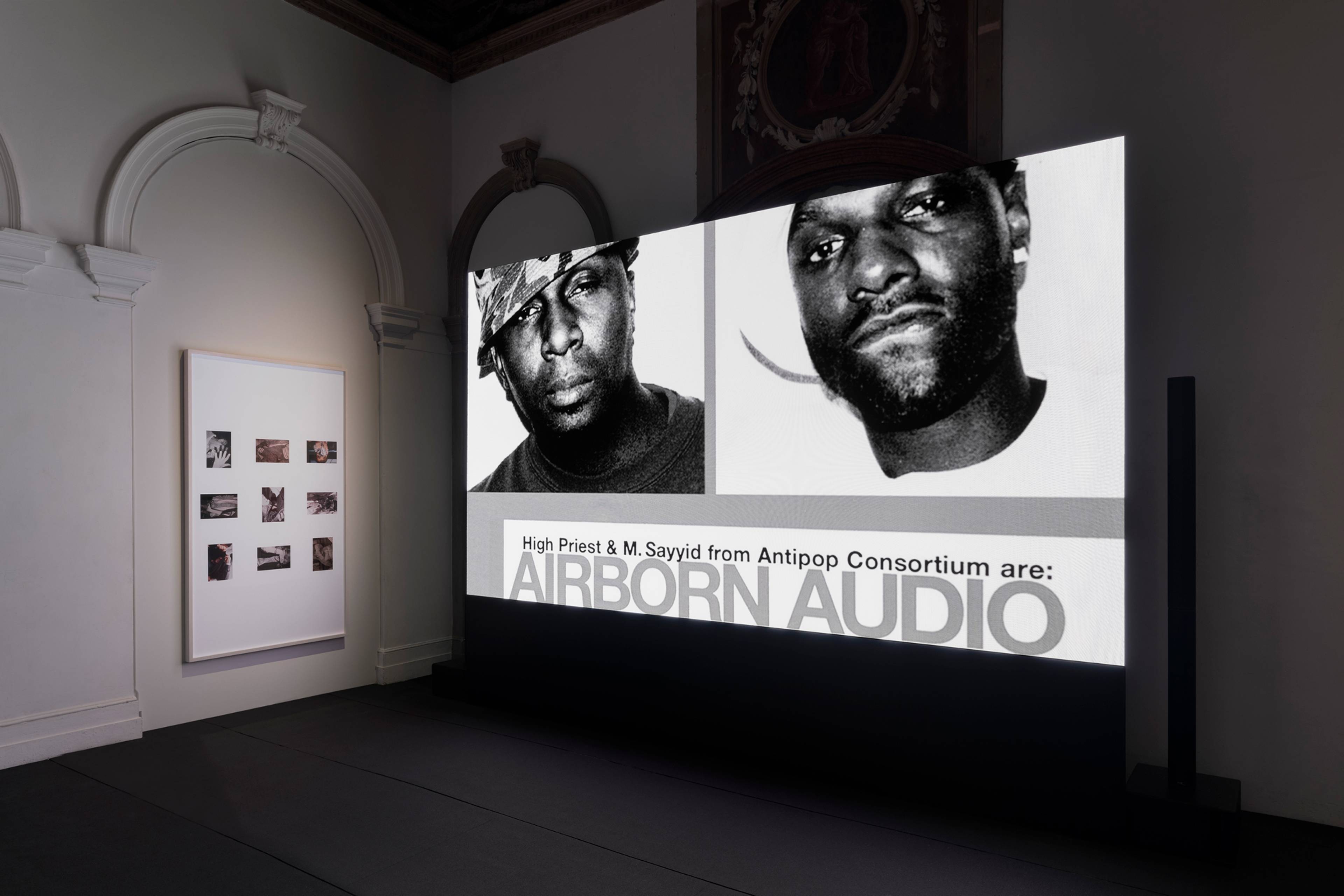
Left: Richard Prince, Criminals and Celebrities, 1986; right: Arthur Jafa, SloPEX, 2023
“Helter Skelter: Arthur Jafa and Richard Prince”
Fondazione Prada, Venice
9 May – 23 Nov 2026