

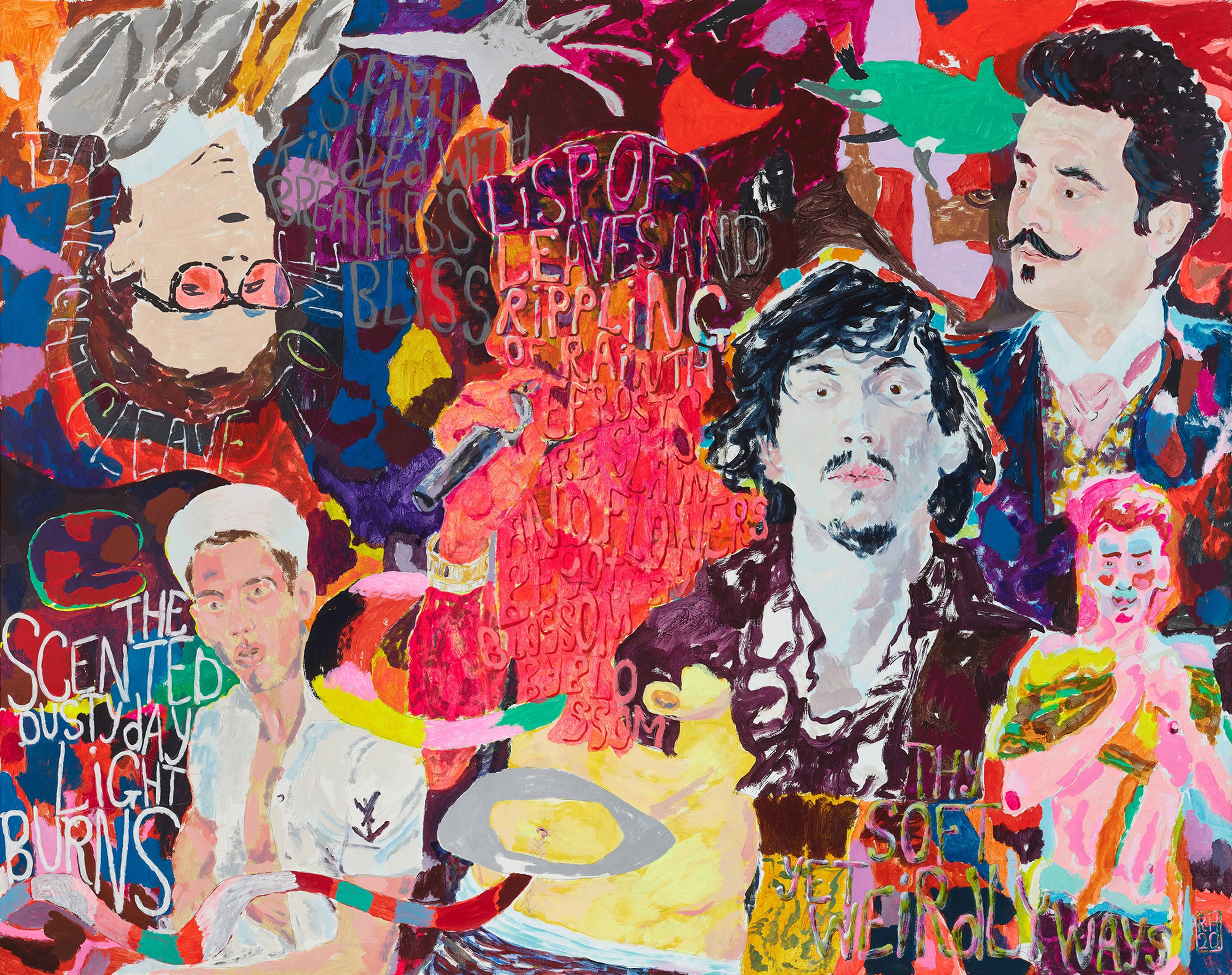
“Jesus is still the most erotic male image in painting today,” Marlene Dumas once wrote. I was reminded of the South African-Dutch painter’s aphorism when I visited the large Richard Hawkins (*1961) exhibition at Kunsthalle Wien. For Hawkins’s painterly compositions almost exclusively depict images of male humans: some nudes, other dressed, some of them included for erotic affections, others simply for their physical attributes, whether as porn actor or athlete. I somehow puzzled over the artist’s view about male imaging, asking myself why there is neither Jesus nor a single female portrait in his repertoire, save for one reproduction of the Holy Family and one Tahitian, Gauguin-style woman, the latter of whom appears in a pinboard-type painting, together with some ancient statues and half-naked guitar players. Obviously, Hawkins has his own, non-religious interpretation of male representation, and surely a different idea of masculinity than Dumas. But what might that actually mean?
It came as quite a coup that Hawkins, who is not so known among a broader art audience in Europe, has his first major show in Austria at Kunsthalle Wien. He is showing works from this century, with a clear focus on a body of newer paintings made in the 2020s. If one can’t exactly tell what Hawkins’s thematic interest actually is, his style is easy to discern. His extremely colorful canvases very often draw from all sorts of media, whether films, TV series, or Instagram feeds whose characters, overwhelmingly youngish guys, he arranges in exuberant spatial settings, be they allusions to landscape, or those overwhelming mixes of patterns that allow his method generally to be called collage. Take two most recent works: Dandy Floriculturists (2025) shows some strange-looking men (actually just their heads and, in one case, one’s breasts) emerging from a deliriously patterned background, including two top-hatted men cribbed from a 2018 TV adaptation of Victor Hugo’s Les Misérables (1862), while in “That one night all those cute guys showed up …” (2025), it’s the faces of actors Adam Driver and Timothée Chalamet, the latter generated by AI, that pop up like décapités from the lush garden of a summer night’s dream.
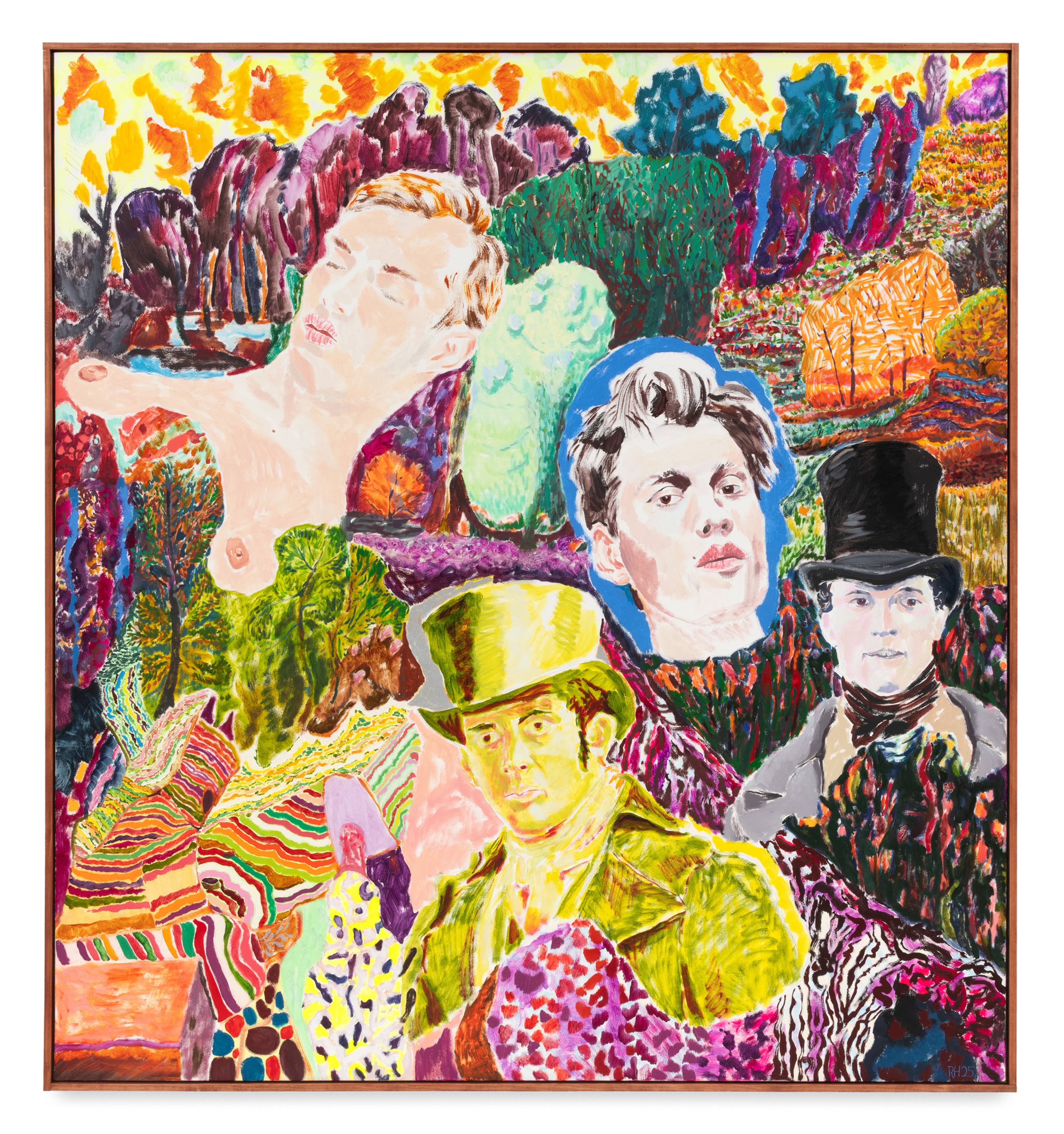
Richard Hawkins, Dandy Floriculturists, 2025, oil on canvas in artist's frame, 192 x 180 cm
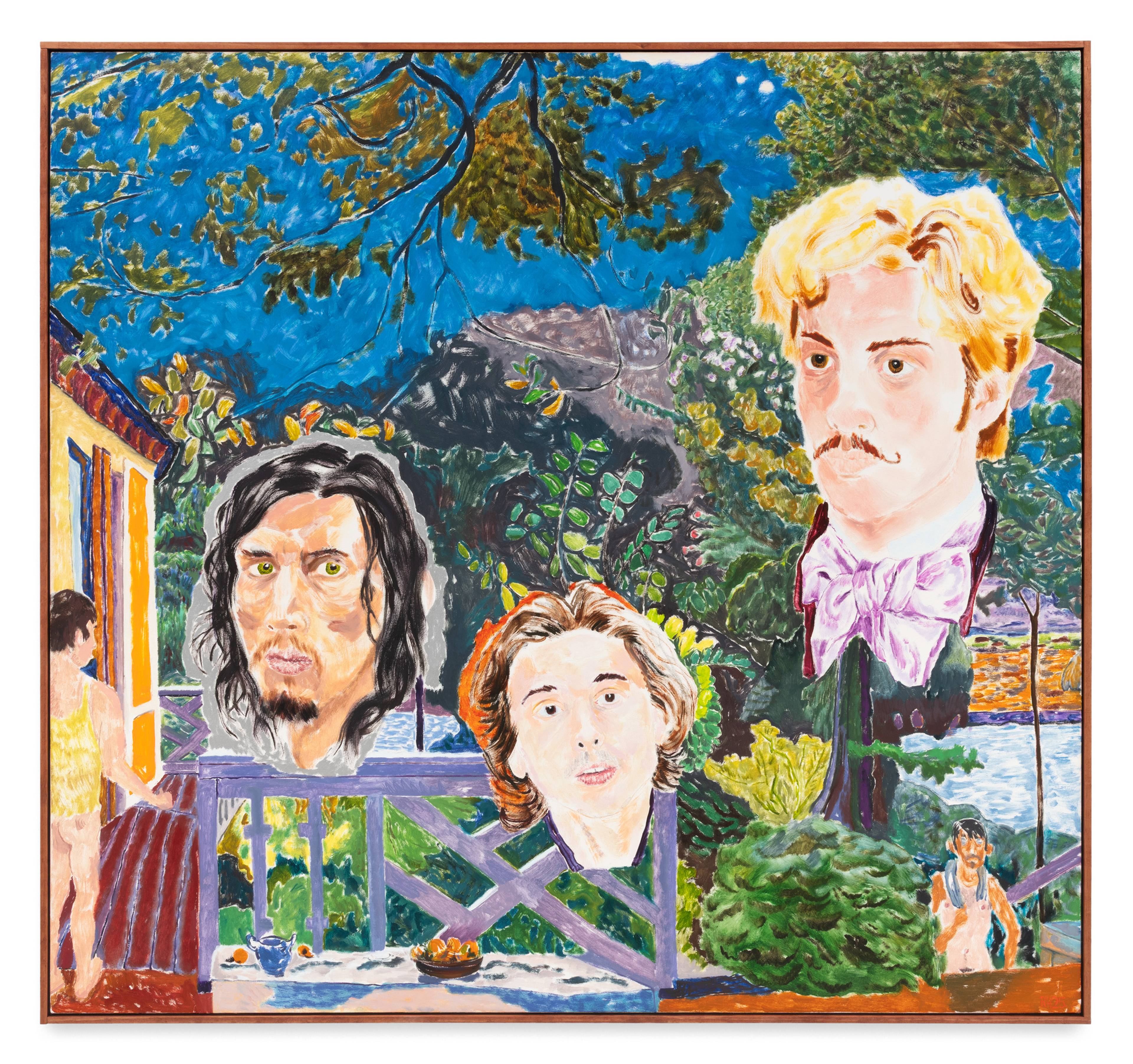
Richard Hawkins, “That one night all those cute guys showed up...”, 2025, oil on canvas in artist’s frame, 179 x 194 cm
Thus, his first overarching theme would probably be an appropriation of different pictorial styles amounting to cultural cannibalism. Hawkins plays with the unsuspecting, cheerful gesture of late Impressionist Pierre Bonnard, visible 1:1 in the backgrounds, sometimes a bit clumsily copied, of more recent work. In a series of acrylics from 2019–24, we see other pattern mashups, from Op Art and AbEx to graffiti, again exclusively in copied-and-pasted heads, reflecting an obsession with styles and iconic imaging that is fascinating and altogether funny. Painting, here, comes as a search (Hawkins himself would rather call it “quest”) for self-determination and identity, a method of deconstructing rigid formalisms that intersect, so to speak, with his own socialization; in his case, an upbringing in provincial Texas. But the artist has also done in-depth research into several ephemeral and clandestine topics: “The Forrest Bess Variations” (2022–23) adapt paintings where late artist and fellow Texan Forrest Bess alluded to the enhancement of sexual – and perhaps transcendental – pleasures through penis incisions, while other of Hawkins’s series extend (homo)sexual and hermaphroditic erotics into preoccupations with the Japanese dance Butoh and Antonin Artaud’s notion of liberating the subconscious through “primitive” ceremonial experience.
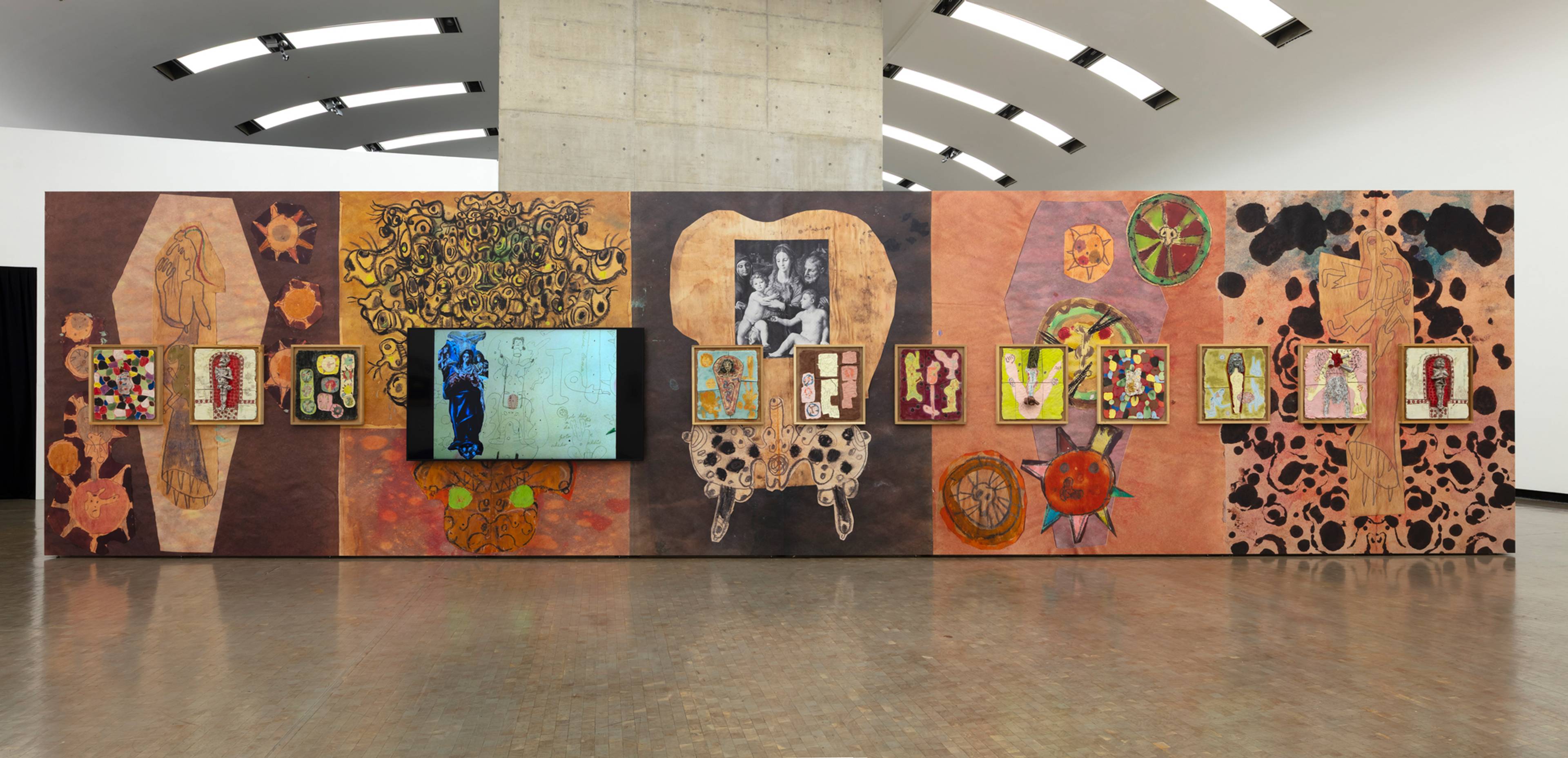
Views of “Potentialities,” Kunsthalle Wien, Vienna, 2025
Up to this point, we’ve followed the artist un-contradicted. With his mixes of wildly different genres of pop culture, cult history, and gay protagonists (including Gustav Aschenbach, from Thomas Mann’s 1912 novella Death in Venice), his rooting in the countercultural attitude of the 1990s would seem to summon the spirit of his onetime teacher, Mike Kelley. But Hawkins also indulges in what he calls a “reimagining of one’s gay self” by obsessively searching for other “forms of affectation,” such as a higher “Frenchification” (that of Bonnard, but also Marcel Proust) to which he ascribes all kinds of principles of masculine daintiness. To quote from an interview he gave critic Bruce Hainley for the exhibition’s forthcoming catalogue: “Principles like ‘duplicity, grandiosity, pretence, flamboyance, obscurantism, self-exoticising, ‘putting on airs’ and a certain ostentatious sesquipedality, though derided and ridiculed as ‘that fu-fu lame shit,’ were merely my early attempts to differentiate myself from the shallow limitations of origin.”
Against my own impulse to read this gay subcultural refinement as an anti-feminist archive, or even as a genuine backlash against women’s emancipation (because male representation had for such a long time been the world’s only representation), I would prefer to draft a different defense for Hawkins’s evocative approach: namely, as a nonlinear conception of the world, one in which counter-narratives and personal preferences establish their own universe, and where, independent of gender, everyone should have the right to develop her, his, and their own life script. With the reservation of being accused of intentional fallacy in reverse, I would like to argue that the density of the pulled-out plots behind Hawkins investigations into the male pluriverse is enjoyable per se – and that renders “Potentialities” a worldly pleasure indeed.
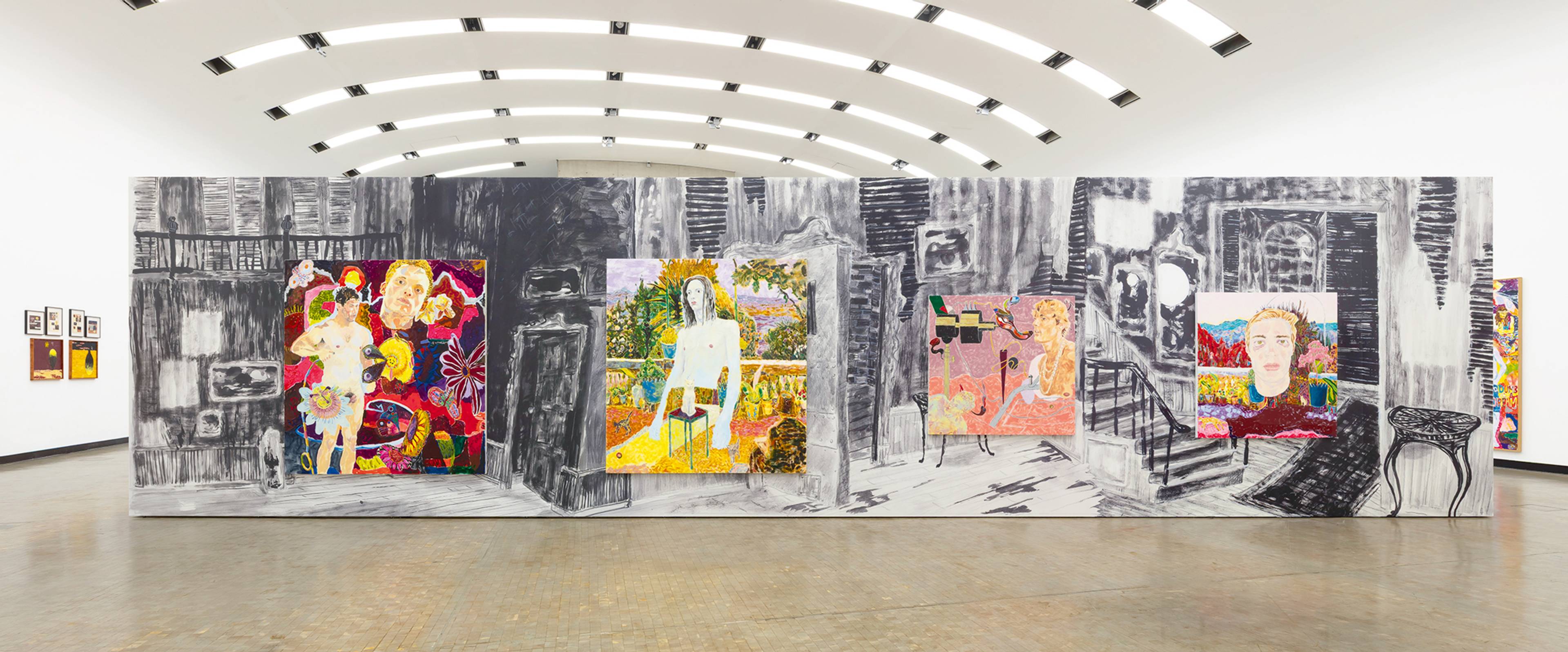
Views of “Potentialities,” Kunsthalle Wien, Vienna, 2025
Views of “Potentialities,” Kunsthalle Wien, Vienna, 2025
Richard Hawkins
“Potentialities”
Kunsthalle Wien
26 Nov 2025 – 6 Apr 2026