

It’s a uniquely deflating sensation, slinking out of a car into a forest of paparazzi and visibly disappointing them by being yourself instead of being Kanye West. I arrived in Seoul to face a small army of flashbulbs and a cadre of Ye fans (one in full black Donda face sock), gathered on a curb, awaiting the rapper’s rumored arrival to an otherwise unassuming warehouse in Seongsu, a district known for immersive pop-up retail flagships like the Jellycat Space Experience and Gentle Monster’s HAUS NOWHERE. For two nights last December, this venue housed Bianca Censori’s solo artistic debut, billed as a “performance and exhibition,” titled BIO POP.
Censori is often introduced as Ye’s second wife, (in)famous for wearing next to nothing and speaking almost never, at once cryptic and hyper-transparent. Trained as an architect, she ascended the ranks as an architectural designer at Yeezy. Ever holding her cards close to her fabulously well-endowed chest, Censori announced BIO POP in a series of characteristically vague Instagram posts in early December, with images of a pressed pill, a mask, and the kind of latex gloves a dominatrix would wear to do the washing up. A press release teased “domestic service reframed as spectacle,” the first “offering” in a series slated to unfold over seven years.
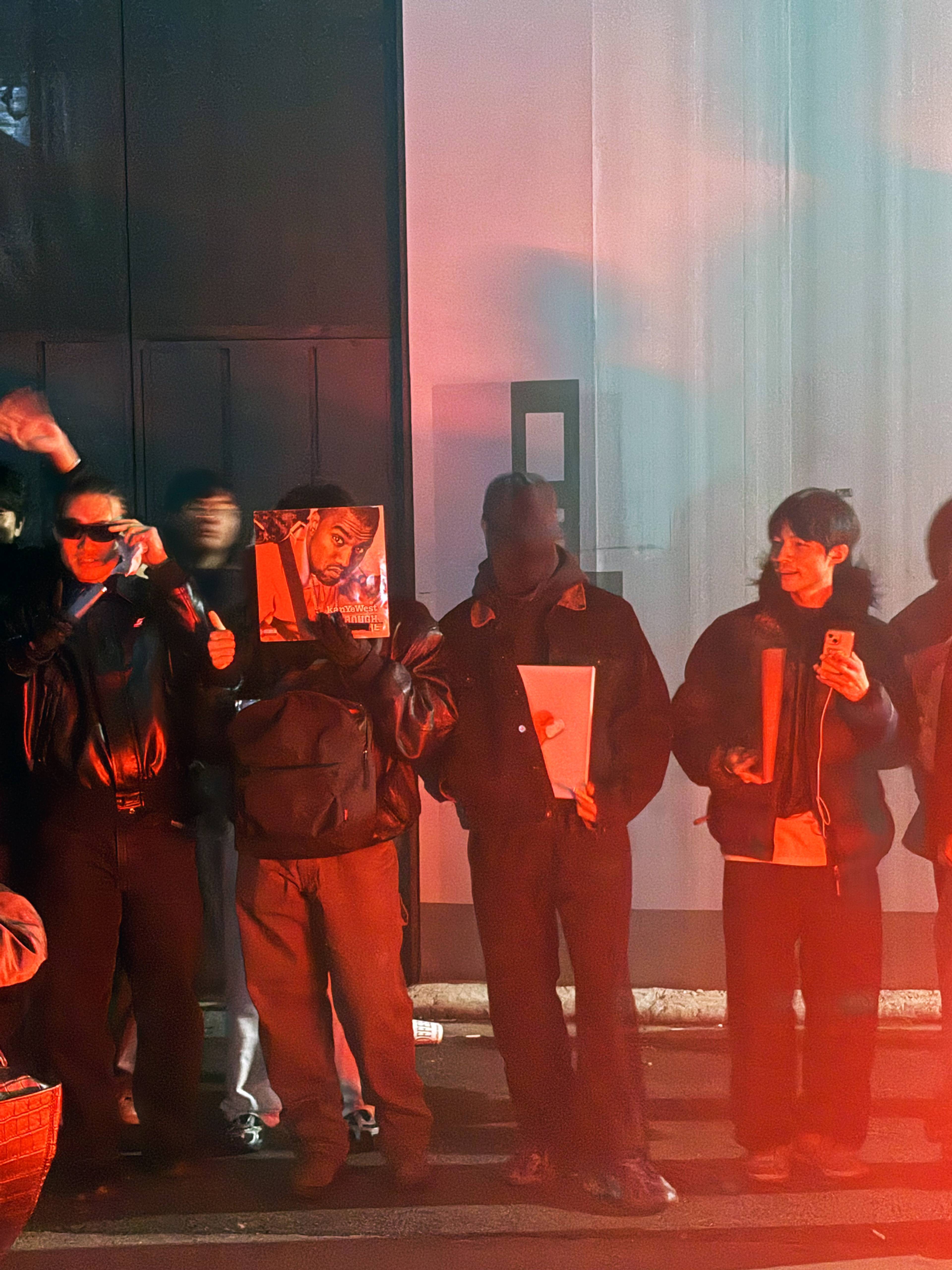
Ye fans outside the debut of BIO POP, Seoul, 2025. Photo: Adina Glickstein
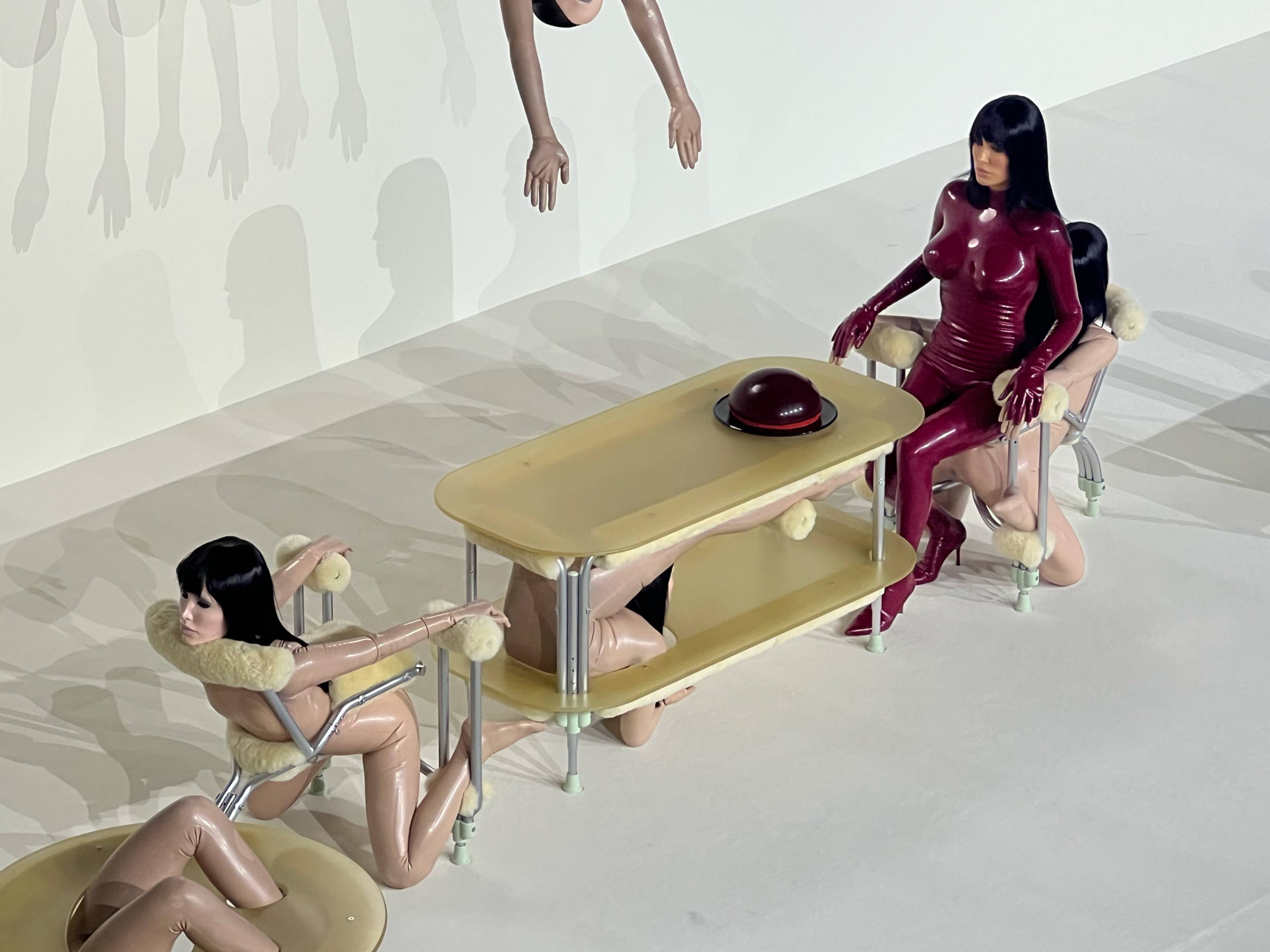
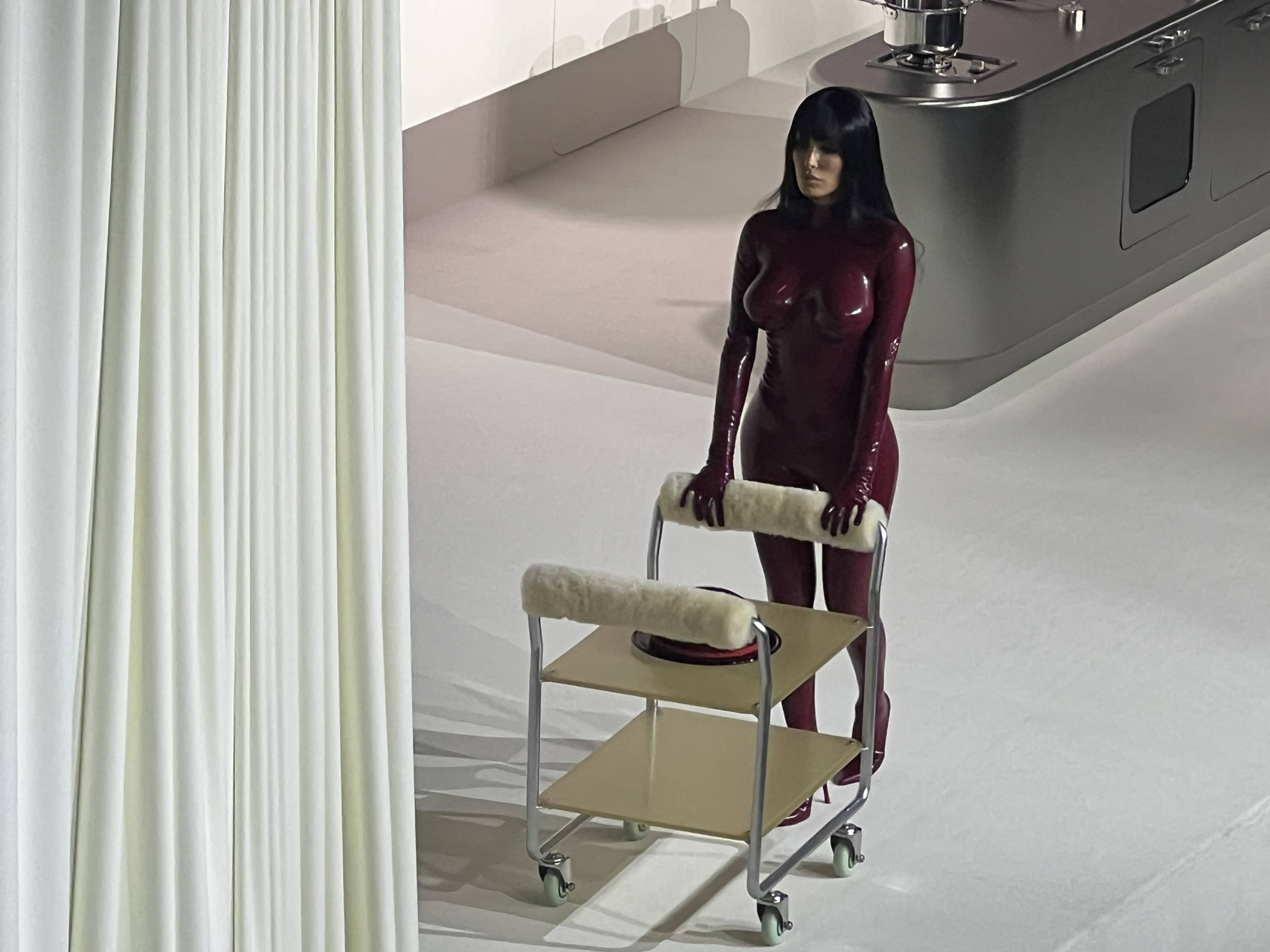
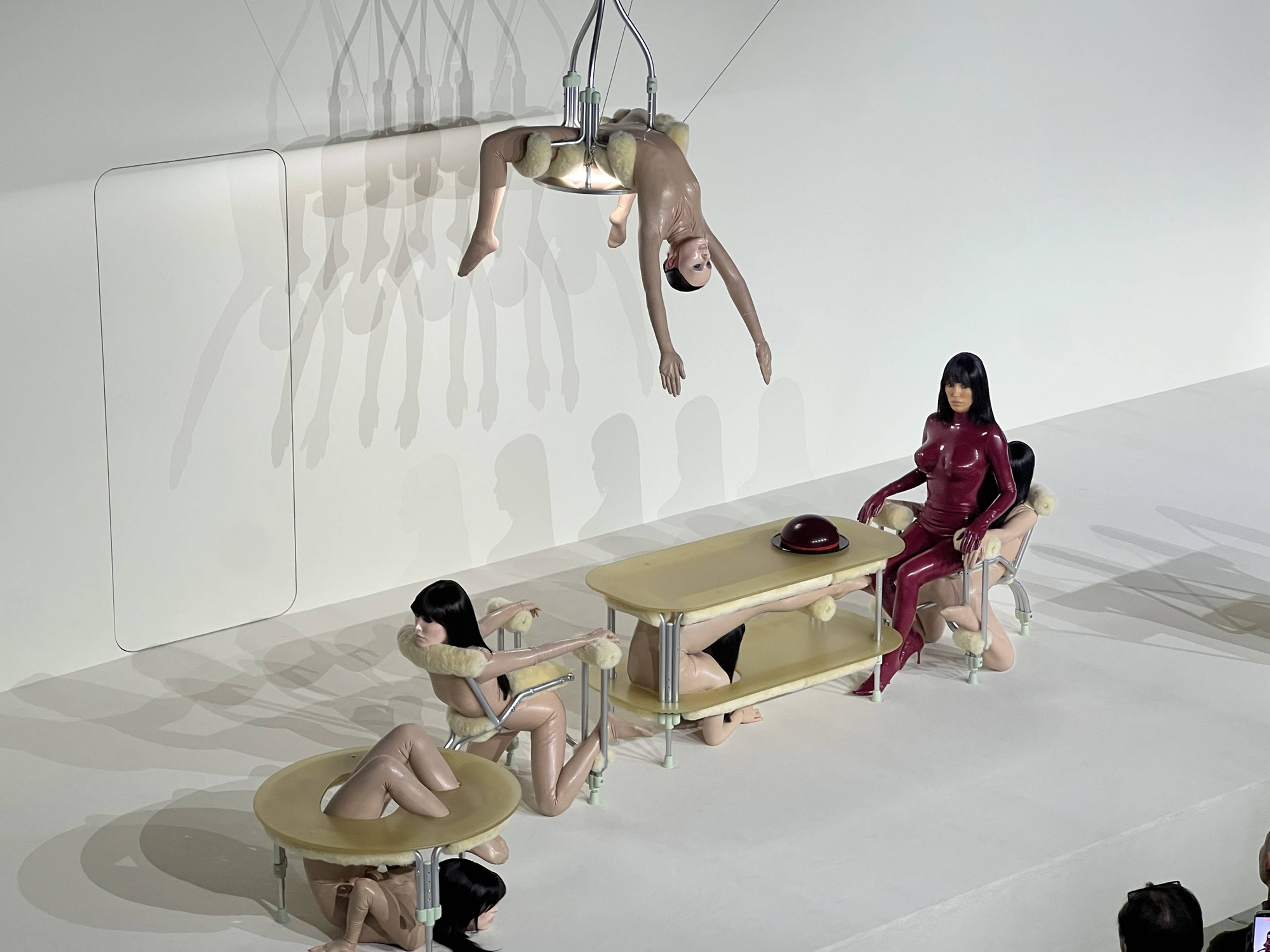
Its first installment, “SERIES 01: THE ORIGIN,” opens on Censori standing in a kitchen of sleek stainless steel, clad in skintight red latex, from turtleneck to pointed toe. But really, it opens before that, as she descends from a catwalk at the rear of the venue, trailed by mother, sister, and Ye. The artist is present, preparing a “cake” – really, a gelatinous oxblood dome – her face frozen in an expression of Stepford Wife placidity. After the concoction comes together, she wheels it away on a bar cart as the wordless, orchestral musical score (a new composition by Ye) is pierced by a scream. White, floor-to-ceiling curtains part to reveal a space-age living room, its coffee table, armchairs, sideboard, and chandelier all made of bent chrome – legs resembling medical crutches – with the bodies of contorted Censori-clones restrained by the furniture’s bends. The doubles wear wigs of her hair and masks of her face, their forms hugged by nude bodysuits designed by Kido Shigenari, aka Kurage, a Japanese fashion designer specializing in – what else – latex. From Censori’s entrance to the clone-furniture’s big reveal, the whole endeavor lasted about fifteen minutes.
The immediate effect in the room was one of buzzy mystery, not least because the dense crowd made it tough to make out exactly what was happening onstage. The best view, I realized during the performance, came from watching the phone screens held in other spectators’ raised hands. Everyone who was there needed you to know that they had been there (present company included); everyone wanted their own little snippet of content, the clout-grabbing equivalent of seizing a piece of the Berlin Wall as it came down.
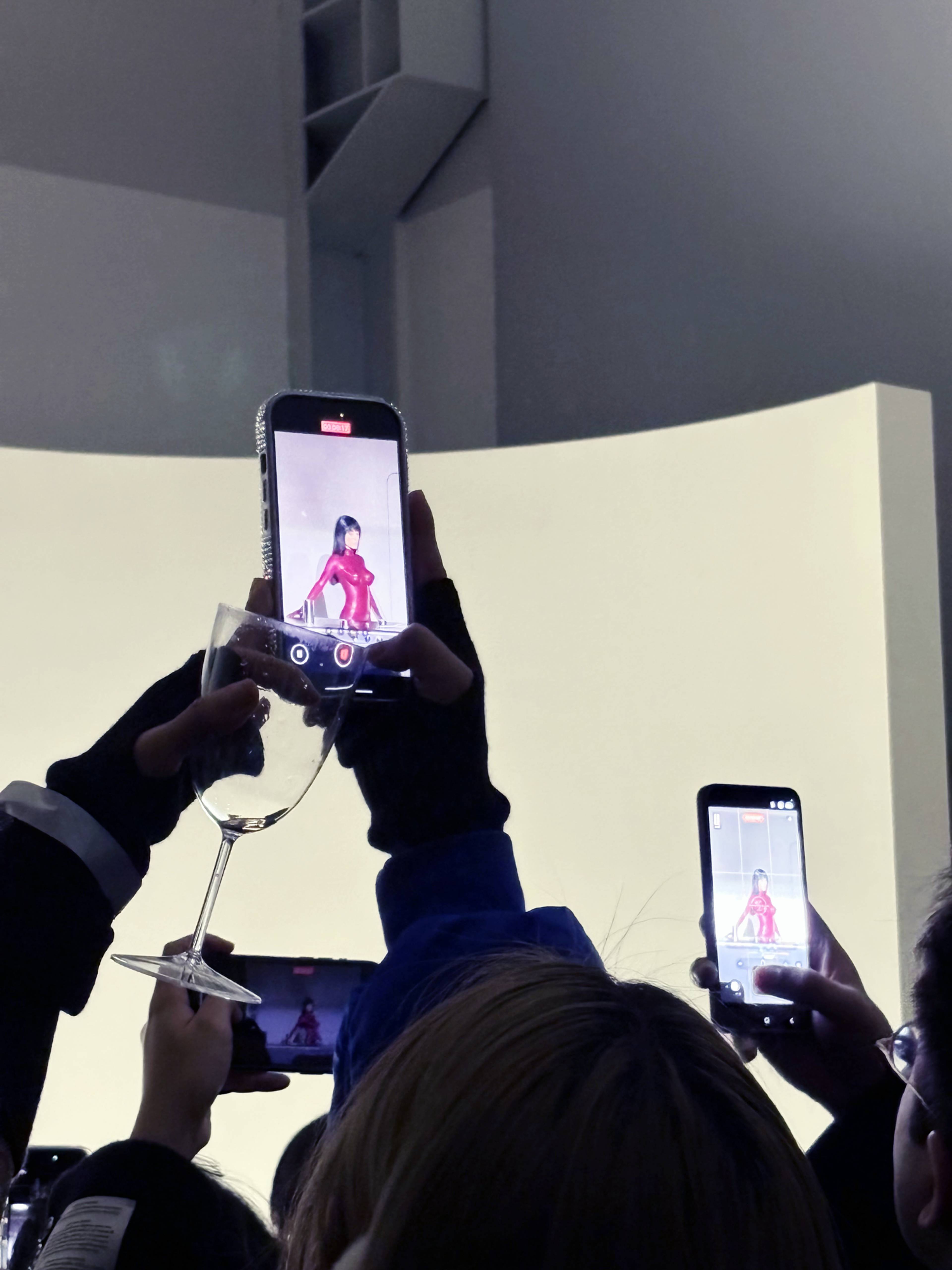
BIO POP as seen through audience phones, Seoul, 2025. Photo: Adina Glickstein
I returned the next morning to interview Censori – or Bianca, as everyone around the set kept referring to her; a first-namer like Madonna or Björk – hoping for a bit of explication. A modelesque stagehand brought me in through a back elevator, but somehow, I never quite felt behind the scenes. For even this ostensibly intimate space, cordoned into dressing rooms and temp PR offices by curtained room dividers, her doubles milling around, is a construction that (like Bianca’s skintight bodysuit) simultaneously reveals and conceals. There is no “offscreen space” with Bianca.
In keeping with her established pattern of not speaking to the media, Bianca maintained a vow of silence throughout the rodeo of interviews. I was made to share my questions in advance; Bianca’s answers were issued on printed sheets of office paper, and read aloud by one of the clones, the publicist standing at attention in the corner. Bianca and Bianca 2 sat beside each other, still latex-clad. I read my questions out, unsure where to address them – should my gaze rest on the double while she spoke, or meet Bianca’s fawnish, unblinking eyes? The double’s voice somewhat muffled by the Bianca mask’s lack of a mouth opening, here is what the Biancas told me.
Adina Glickstein: What were the major inspirations behind BIO POP?
Bianca Censori: BIO POP emerges from Bianca’s ongoing project of building a self-portrait inside the architecture of the home. She treats the domestic space as the first system most bodies inherit – the place that shapes behavior, posture, and identity long before language arrives. In her world, the kitchen becomes an origin point, the dining room becomes ritual, and the doubles embedded in the furniture become extensions of a domestic body itself. The work collapses binaries: comfort and confinement, home and shrine, body and object. Rather than illustrating domesticity, Bianca exposes its architecture: the symbolic structures that script how a body moves, serves, adapts, and resists.
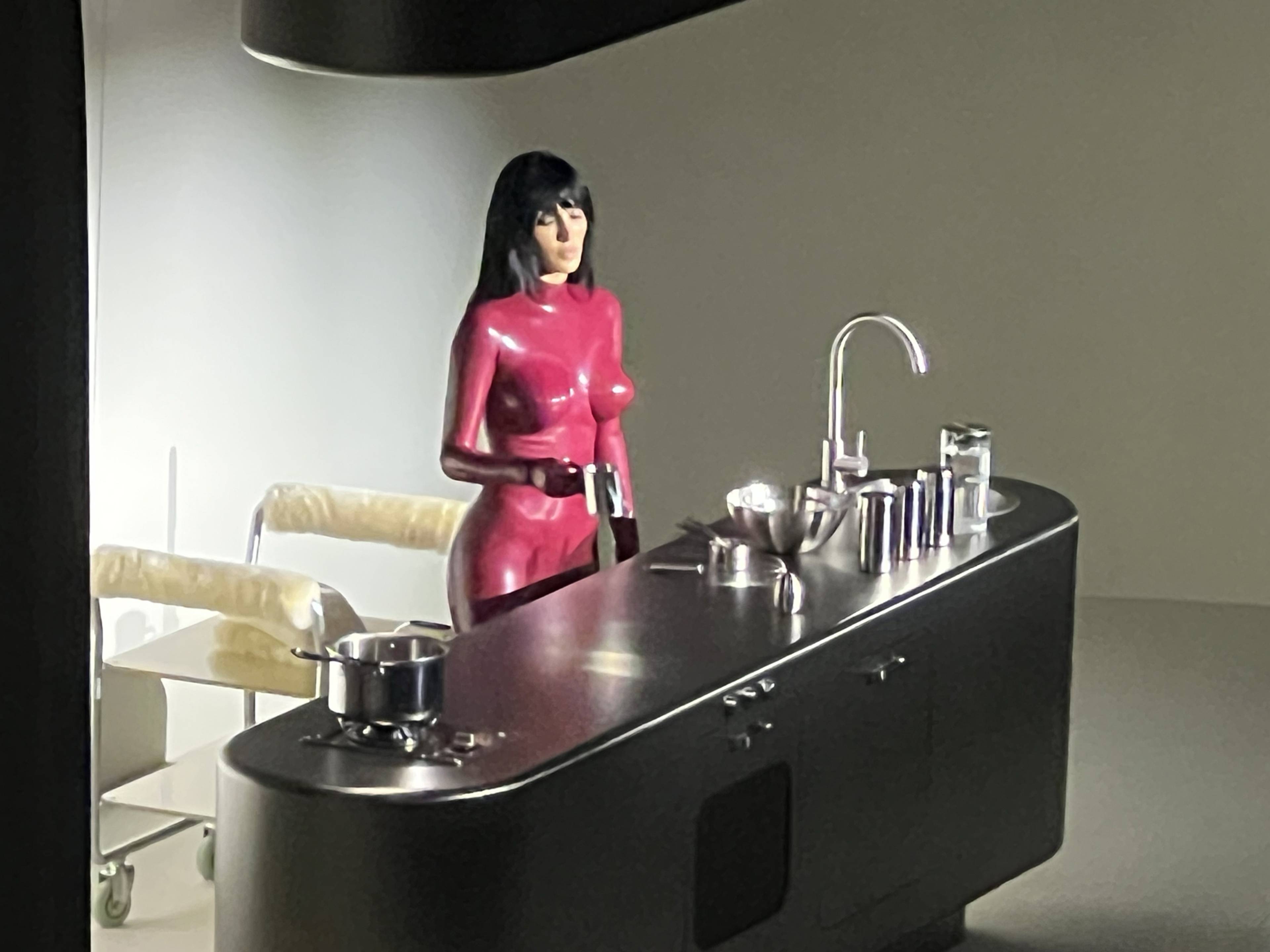
Bianca Censori, BIO POP, 2025. Performance documentation, Seoul, 2025. Photo: BTS
AG: How did your training as an architect inform the way you think about the domestic space as a site of resistance?
BC: Bianca’s architectural training taught her that space is never passive: it choreographs the body. Domestic architecture in particular encodes instructions: how to sit, how to work, how to behave, how to shrink or extend yourself in response to its cues. Because she can read these structures, she can also read their fractures and inheritances. In her sculptural work, she alters domestic forms so the body can no longer perform seamlessly. These destructions create small sites of resistance: moments where the body slips out of its learned scripts and reveals the biases built into the home. In that sense, resistance begins with a simple act: misusing the architecture.
AG: What can we expect over the next seven years of the cycle? How did you decide to make the performance last this long?
BC: Bianca uses seven as a temporal structure: ritual-renewal-sequencing. The work requires duration because identity, architecture, and ritual behave across time, not in a single exhibition. Each chapter occupies a different symbolic domain. The domestic reliquary expands into mythologies of doubling, sacrifice, collapse, death, and return. As performers’ bodies change and cultural conditions shift, the work absorbs those changes into its own evolving architecture. The cycle will travel across cities, allowing each site to become another chamber in the larger system. Over seven years, the project becomes a world: a longform performance language and a living archive of inherited rituals.
AG: How are you staging femininity as itself a kind of technology in this work?
BC: Bianca approaches femininity not as an essence but as a kind of cultural technology – a set of inherited techniques the body learns to perform. She treats it as an operating system rather than identity. In BIO POP, this becomes visible through the doubles: bodies repeating gestures, adapting to architecture, running the same image across many physical forms. The performers’ movements echo the micro-rituals bodies adopt in domestic space – bending, adjusting, anticipating, enduring – actions that feel natural because they’ve been practiced for generations. Instead of portraying femininity, Bianca reveals its mechanics. By distributing her face across multiple bodies, the performance turns identity into an interface. You’re not meeting one woman; you’re encountering a symbolic operating system running through many processors. The work shows how these inherited scripts can be automated, resisted, or glitched.
AG: Why did you choose Seoul as the location to debut BIO POP?
BC: Korea is one of the few places in the world where futurism, tradition, and public image move at the same speed. It is one of the cultural engines of the 21st century, shaping global aesthetics, technology, performance, and identity. BIO POP belongs here because Korea understands the body as something performative, architectural, and symbolic. The Korean audience has an instinct for experimentation and a deep sensitivity to form and ritual, and that makes Korea the ideal place to begin a work that challenges the boundaries between body, object, and domestic space.
☆
These answers, in their obliqueness, verged on the prophetic: it felt a bit like what I imagine it would be to speak to the Oracle at Delphi – mediated by a Sibyl within the temple of spectacle. Or maybe it felt like querying a Bianca-bot. I had no way of verifying whether the answers were originally written by her, or by her PR, or indeed by artificial intelligence. Perhaps the indistinction between fembot and chatbot is a put-on, a part of the performance as calculated as every other.
As onlookers grasp to make sense of BIO POP, the work has taken shade for allegedly ripping off the British artist Allen Jones’s Handstand, Table, and Chair (all 1969), or the sculptures of Swedish artist Anna Uddenberg – two referents, one critical and one perhaps less so, where women’s bodies are contorted into modernist furniture. I think the detractors give Bianca short shrift; the performance could just as well be read in reference to any number of touch-points, say, Martha Rosler’s Semiotics of the Kitchen (1975) – a second-wave feminist parody of cooking demonstrations – or a cinematic canon including Chantal Akerman’s Jeanne Dielman (framing the domestic as a space of both agency and violence; 1975); Ingmar Bergman’s Persona (doubling, resemblance, projection, silence; 1966); even Olivier Assayas’s Irma Vep (all about re/production, femmes fatales, spectacle, and saucy catsuits; 1996). Zooming out, I see Bianca’s public muteness as being in (silent) dialogue with durational, rules-based performance art like Lee Lozano’s Decide to Boycott Women, a conceptual performance wherein, as advertised, she ceased talking to other women from 1971 until her death in 1999. (Lozano’s work was also derided in its time for “reinforcing misogyny.”)
Whatever its inspirations, the fact that BIO POP has conjured such varied and intense reactions attests to the charged nature of the cultural material it metabolizes. In true Yeezy spirit, Bianca is the master of mood-boarding, distilling timely currents into their most essential forms. Yet the work is also strangely blank. Which is to say, it leaves plenty of room for a viewer’s projections. It is the formalization of a longer-running, untitled durational artwork that Censori has been making en plein air: wordlessly performing what it means to be Bianca in the face of the press and the public. She is silent like a psychoanalyst, inviting the projection of our desires, fantasies, prejudices and perversions. She is nearly naked yet somehow still opaque. She is the inherent contradiction at the center of all sexuality, the short circuit between seeing, knowing, having, and being. To dismiss her art practice as merely derivative or sexist is to wildly miss the point. Or rather, like a Rorschach test, it says more about you than it does about Censori.
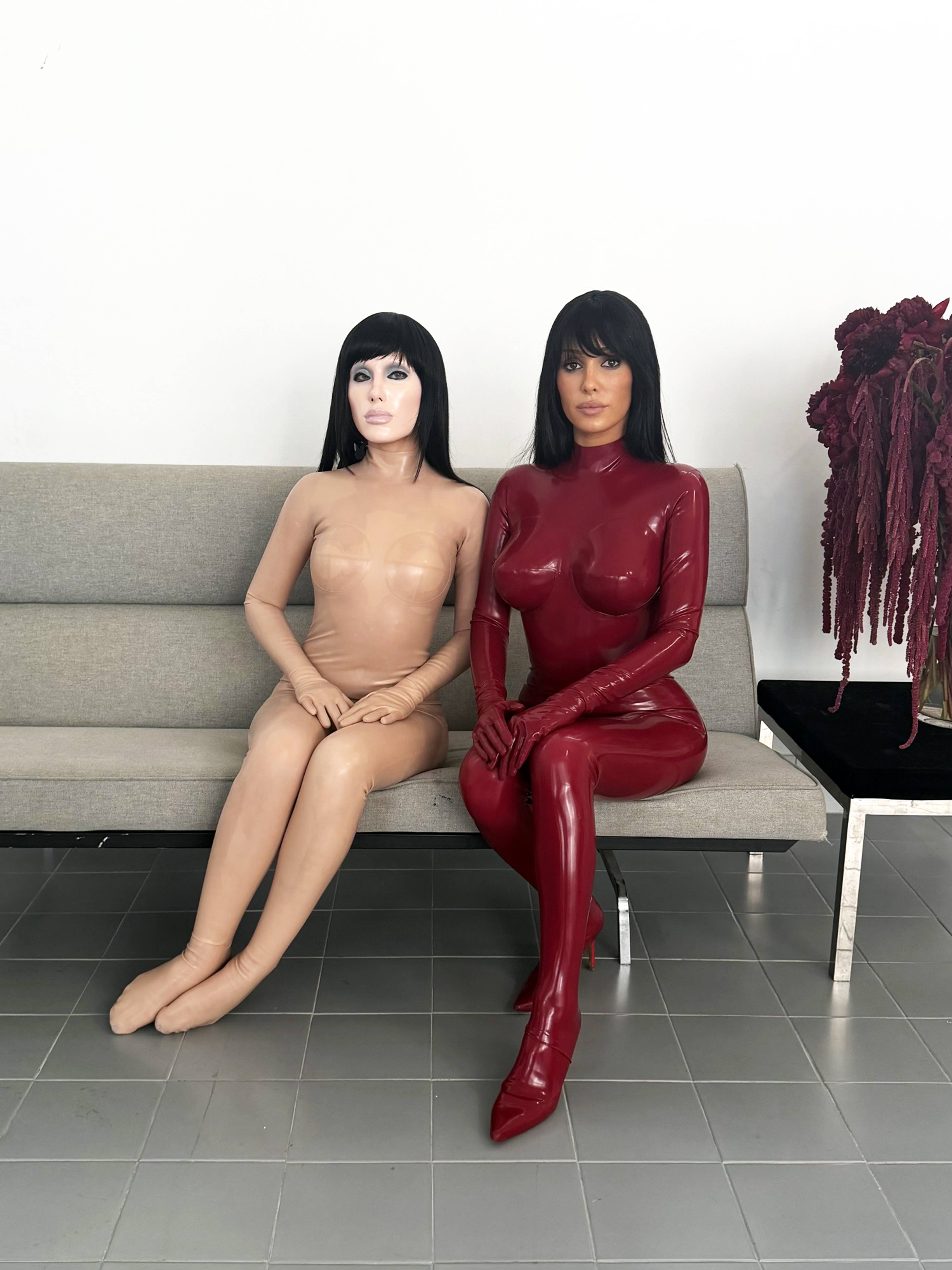
Bianca Censori and her double after the debut of BIO POP, Seoul, 2025. Photo: Adina Glickstein